Nordic Network of Disability Research Conference 2019

I’m sat in Copenhagen airport feeling extremely tired, but also very lucky to have been able to attend the NNDR Conference this year, and present some reflections from my ongoing research project. Like previous disability studies conferences I have been to, this conference was welcoming, mostly accessible, and thought-provoking. I had the chance to meet new colleagues from across the globe, share ideas, and gain an insight into the many different areas of research currently situated somewhere under the broader and intersectional umbrella of disability studies.

The hashtag #NNDR2019 is the best place to reflect upon, or catch up on the conversations shared throughout this conference. In this blog, I hope to write some of my own reflections from the event, which will regrettably cover only a small proportion of the diverse papers presented over the last few days.

Wednesday 8th May, 2019

The first paper of the conference was a keynote delivered by Prof. Jesper Vaczy Kragh. In this, he presented a history of institutionalisation in Denmark and introduced us to some key figures in this push towards the medicalisation of disability, such as Keller and Steincke. Both of whom, were also early proponents of forced sterilization and castration under the premise of eugenic logic, that ‘the existence of tainted individuals will deteriorate the fit, and accordingly, the average intelligence of the population’ (Steincke). He traced developments in the 1900’s, as well as the seeming shift back towards reinstitutionalization.

In the Gender, Body and Sexuality stream, Rebecca Fish and Yani Hamdani offered gendered perspectives of autistic girls and women, and experiences of violence in locked wards. These papers raised important questions considering the way that women are perceived to, and do experience different forms of violence and behaviour management.

The symposium, Troubling the Best Welfare State There is, asked important questions about how discourses and practices surrounding welfare were contributing to particular ideas around disability identity. Lill Hultman discussed some of the issues relating to the assessment process of personal assistance (PA) in Sweden, Lina Palmqvist considered the intersection between age and disability within the context of austerity, and Niklas Altermark criticised the discursive construction of PA funding as a problematic, burdensome cost.

Thursday 9th May, 2019

In the first keynote of the day, Prof. Katherine Runswick-Cole drew upon critical disability studies as a means of thinking about the construction of the family within ‘neoliberal-ableism.’ She highlighted the discursive construction of ‘us’ against ‘them’ through the rhetoric of ‘hardworking families’ and ‘troubled families.’ While ‘hardworking families’ are bolstered as adaptable, and the site to challenge societal ills, so-called ‘troubled families’ are marginalized as the cause of such social problems. Katherine drew upon the possibilities and risks associated with mother activism, and recommended the need to resist individualisation, to use and reuse the norm, and to engage with ‘advocacy-activism’ as a form of resistance.

In the session, ‘Society and Disability in Exclusion/Inclusion Perspective, speakers considered how disabled people were both included and excluded within particular contexts. Scott Avery presented an intersectional analysis of discrimination across the life trajectory, Mariela Yabo and Dori Rivkin described and evaluated a project to include young disabled people in Adult centres in Israel, and Elise Milot presented some reflections on a social inclusion and community participation project for ‘adults with intellectual disability’ in Quebec. Finally, Ian Matthews analysed the representation of disability within media stories, drawing upon stereotypes of vulnerability and innocence.

In the symposium, Disablist Hate Speech, editors and authors of an upcoming book presented understandings and findings relating to experiences of disablist hate speech. Opening the symposium, and providing an overview of the book, Mark Sherry outlined some tensions inherent within hate speech law, particularly thinking in terms of an international context. Following this, Mark discussed some of the unique ways that online hate speech was targeted disabled people, with the explicit motivation of causing physical and emotional harm. Next, Erin Pritchard drew attention to the problematic use of the word ‘midget’ in media and everyday language. Erin challenged continued representations of people with dwarfism as the subject of humour, and called for a ban on dehumanizing and derogatory representations. Line Melboe gave examples of the experiences of Sami disabled people, drawing attention to the complex intersections of identity. Finally, Terge Olsen engaged with Carol Thomas’ work on psycho-emotional disablism to document the way in which hate speech can contribute to barriers to doing and barriers to being.

Friday 10th May, 2019

In a session titled ‘Disability, Stigma and Coping Strategies,’ I delivered my paper on some preliminary reflections on my ongoing PhD project. I focused on three key analytical questions concerning how hate is understood, how it hurts, and how it is negotiated in everyday life. I wanted to draw attention to the importance of recognising everyday hate, but also to the intricate ways that disabled people are negotiating and resisting these. Next, Alise De Bie explored some of the coping strategies enacted by services users of mental health services. Alise emphasized the importance of reading for resistance within data to better understand the different ways that people are challenging mainstream discourses. Finally, Patrick Jachyra positioned and problematised medicalised discourses surrounding autism, and then shared research findings that shed light on why some young people diagnosed with ASD may become disengaged with physical activity. Specifically, he detailed some of the dangers associated with engagement with physical activity, such as being bullied in changing room spaces.

Final Thoughts

Unfortunately, after the morning’s presentations my energy levels dipped and I was unable to make any comprehendible notes. I am, however, left with many thoughts that I try to make sense of over the next few weeks. In particular, I have been thinking about the values and motivations underpinning disability research, and how this influences the ways in which disabled people are included (or not) in the research process. I have been thinking more about the importance of recognising and indeed, harnessing, the diverse forms of resistance that disabled people enact within the context of their everyday lives. And I am thinking about the potential for international collaborations, and in particular, how I myself can engage more with growing disability studies literature in the Global South, and the values that such perspectives would offer.

Special thanks to everyone involved in the organisation of NNDR 2019, and to all of the wonderful researchers, activists, advocates, and policy-makers that attended.
Organisations involved in the project

Throughout this project, I have been working closely with 6 organisations, based in Leeds, Liverpool, Manchester and Birmingham. In this post, I would like to share more information about the fantastic work that they all do to work with and support disabled people.

Leep1 – Leeds People First

Leep1 are an organisation for people with learning disabilities based in Leeds. Members of Leep1 help with the planning and running of campaigns, training events, and community work. Leep1 also hosts weekly social nights, workplace training in their cafe, and events such as fashion shows, speed dating and club nights. Members have been involved with important community work to help challenge negative attitudes towards people with learning disabilities. They have also been working with local schools to raise awareness about hate and mate crime. This includes performances, as well as creating a rap.

Cerebral Palsy Midlands – Birmingham

Cerebral Palsy Midlands is a charity based in Birmingham that empowers and supports people with Cerebral Palsy. The charity offers a range of activities for members to get involved with on a daily basis, including Thai Chi, exercise, storytelling, and art. They also offer support with life skills, such as cooking, literacy and numeracy. In addition to their daily activities, Cerebral Palsy Midlands organise a range of social events to raise money for the charity and ensure the most relevant support and opportunity is available to their members. This includes club nights, sponsored ‘Wheel n Walks’ and BBQ’s. Members also get involved with local campaigns and initiatives, and are currently supporting #GetBirminghamGreen.

People First Merseyside

People First Merseyside are an organisation that is led by and with people with learning disabilities, based in Liverpool. Members of People First Merseyside encourage all people with learning disabilities to speak out, ensure they are respected, and live a happy life. Members are involved with the organisation and planning of meetings, events, and day trips. The group are involved in a number of community projects and events, and run campaigns that are relevant and useful for people with learning disabilities. The members work closely with the police to ensure people are safe in the community, and offer training to those that work with people with learning disabilities.

Resolve – Care Network Hub, Blackburn

Resolve are a hate crime support group based at Care Network in Blackburn. Members of this group meet weekly to share experiences as well as catching up with friends and supporting one another. Many members of the group are part of steering groups and planning boards to ensure that they are able to share their views on matters that are important for disabled people in the community. Members are regularly attend learning disability conferences.

LGBTQ+ Group, People in Action, Leeds

People in Action are a charity organisation that works with people with learning disabilities and Autism in Leeds. The charity runs a range of groups and social events on a weekly basis. The LGBTQ+ group, who I have worked with for this project, meet weekly at a range of places, and take part in a number of different activities chosen by members. This includes going out for meals, bowling, and karaoke as well as providing support about being safe, supported, and happy in the community.

Spice – Future Directions, Manchester

Future Directions are a social care provider that work with people with ‘complex needs’ to ensure that they are receiving high quality support to live meaningful and happy lives. SPICE are a user-led group that are part of Future Directions and aim to provide the opportunity for self-empowerment and self-advocacy on issues important to disabled people. This includes supporting training events, developing skills, leading campaigns, and challenging negative social attitudes. The group have also been part of a ‘say no to hate crime’ project, which is aimed at providing educational resources about hate crime, and working closely with the police.

Resolve: arts-based workshop

In this workshop, I asked members of Resolve to create mood boards about their understandings and experiences of hate crime. Huge thanks to all involved, and for their continued support: Elvis, Mary, Amanda Depp, Sinead, John Dovet, Mr Positive, Fifi, Bev, and Joyce.

What is hate crime?

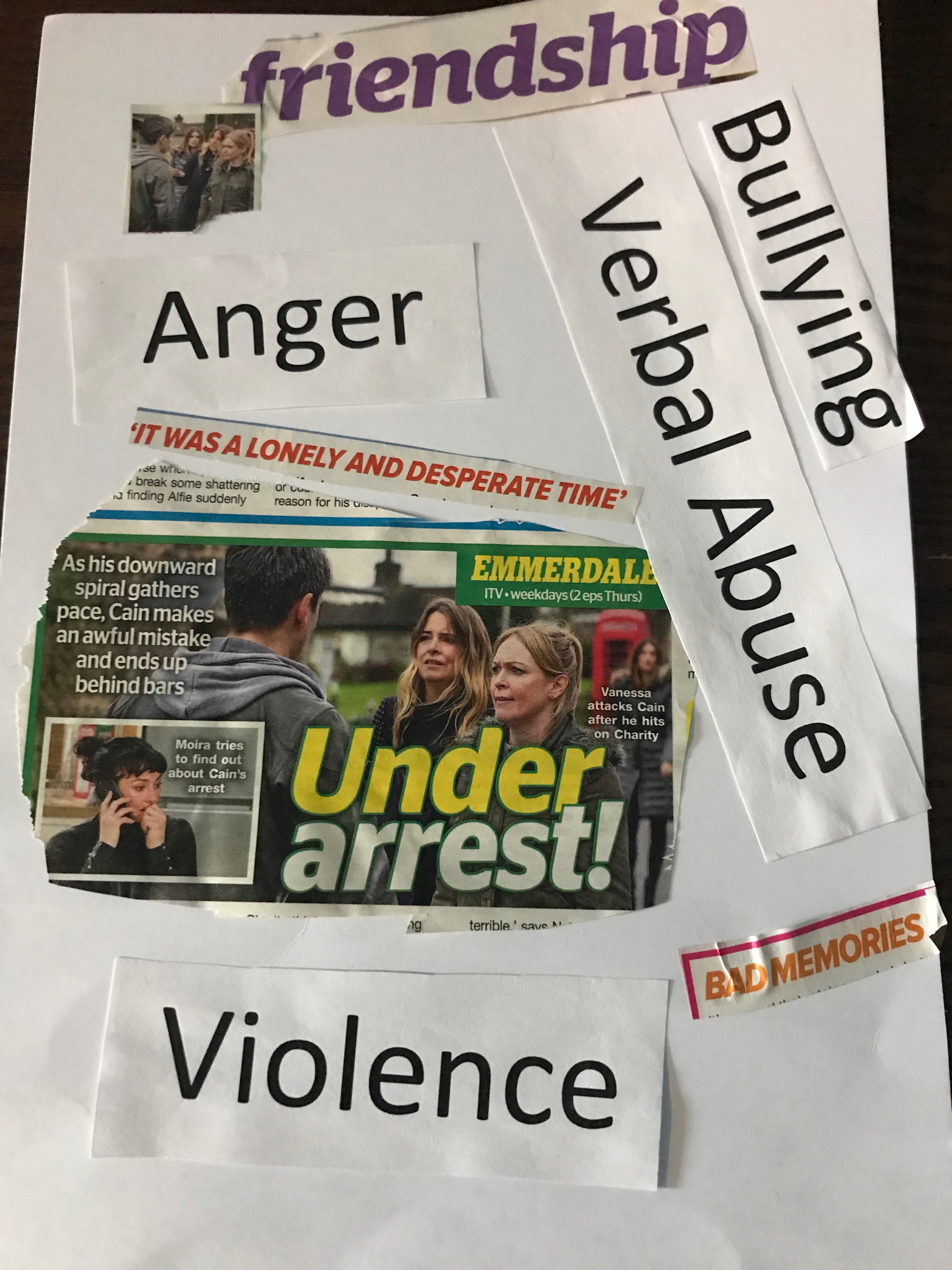
As participants started to look at the resources and think about their mood boards, we shared our understandings of what hate crime is. For most participants, the easiest way to describe hate crime was to reflect upon their experiences of bullying during school. Mary in particular spoke about being picked on and physically abused by another student. In addition, Sinead and John Dovet said that other students would often avoid them during school, because they were seen to be a ‘threat.’

Mary’s mood board: at the top is a cut out of the word ‘friendship’ and a photo of a group of people talking together. Underneath are the words ‘bullying,’ ‘verbal abuse,’ and ‘anger.’ There is a cut out of the words ‘it was a lonely and desperate time’ and ‘bad memories.’ There is a cut out of a scene from Emmerdale with the title, ‘under arrest!’ At the bottom is the word ‘violence.’

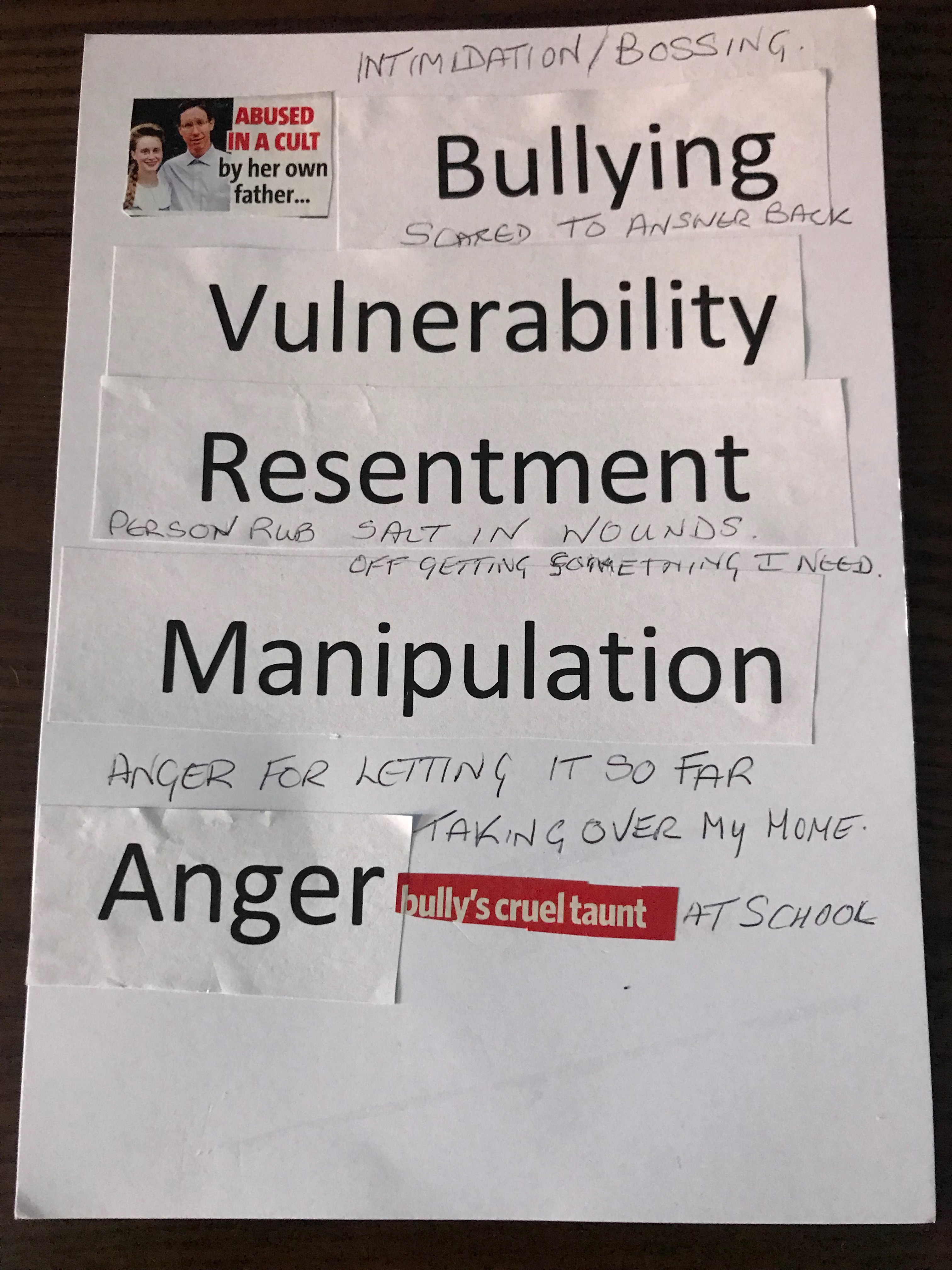
Fifi also reflected upon her time at school. For her, bullying was the ‘norm.’ She spoke about school friends ‘pulling you to pieces’ and making fun of her because she was ‘taller than anybody in the school.’ She explained that this had made her feel very vulnerable, and had impacted the way she thought about herself, and what she could achieve.

Fifi’s mood board: she has wrote ‘intimidation/bossing’ next to a cut out photo of a man and women, with the headline ‘abused in a cult.’ Below she has the words ‘bullying’ and ‘vulnerability’ next to the writing ‘scared to answer back.’ She has the word ‘resentment’ followed by ‘person rub salt in wounds, off getting something I need.’ ‘Manipulation’ is followed by ‘anger for letting it get so far, taking over my home’. The word ‘anger’ is followed by ‘bully’s cruel taunt at school.’

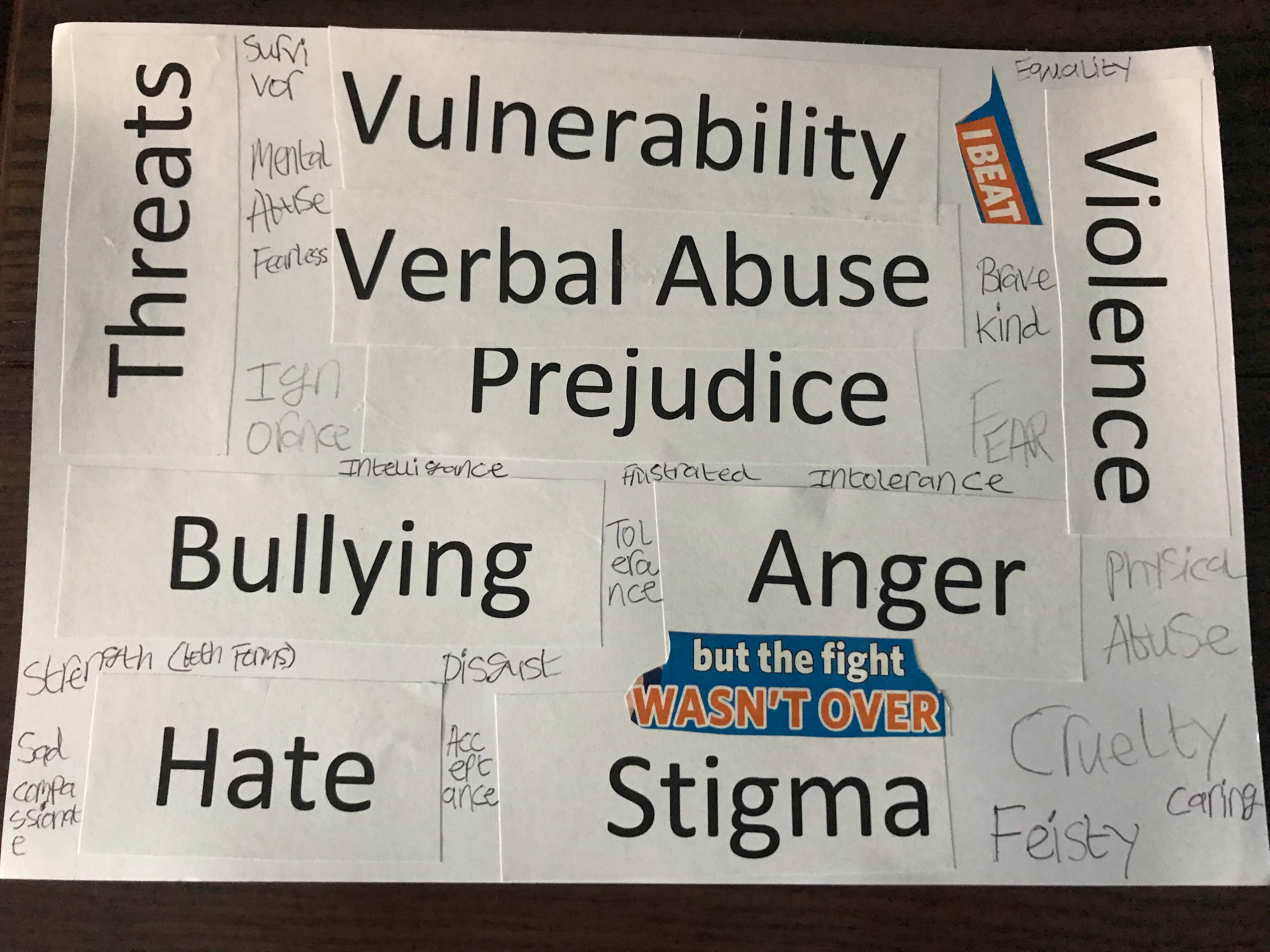
Similarly Sinead discussed ‘mental abuse’ which she understood as continuously putting people down. For her, ‘when they keep telling me you’re not good enough it knocks your confidence.’

Sinead’s mood board: Sinead has used a variety of words. This includes ‘threats,’ ‘survivor,’ ‘mental abuse,’ ‘fearless,’ ‘vulnerability,’ ‘verbal abuse,’ ‘prejudice,’ ‘I beat,’ ‘brave,’ ‘kind,’ ‘violence,’ ‘ignorance,’ ‘intelligence,’ ‘frustrated,’ ‘intolerance,’ ‘fear,’ bullying,’ ‘anger,’ ‘physical abuse,’ ‘but the fight wasn’t over,’ cruelty,’ ‘feisty,’ ‘disgust,’ ‘sad,’ ‘stigma.’

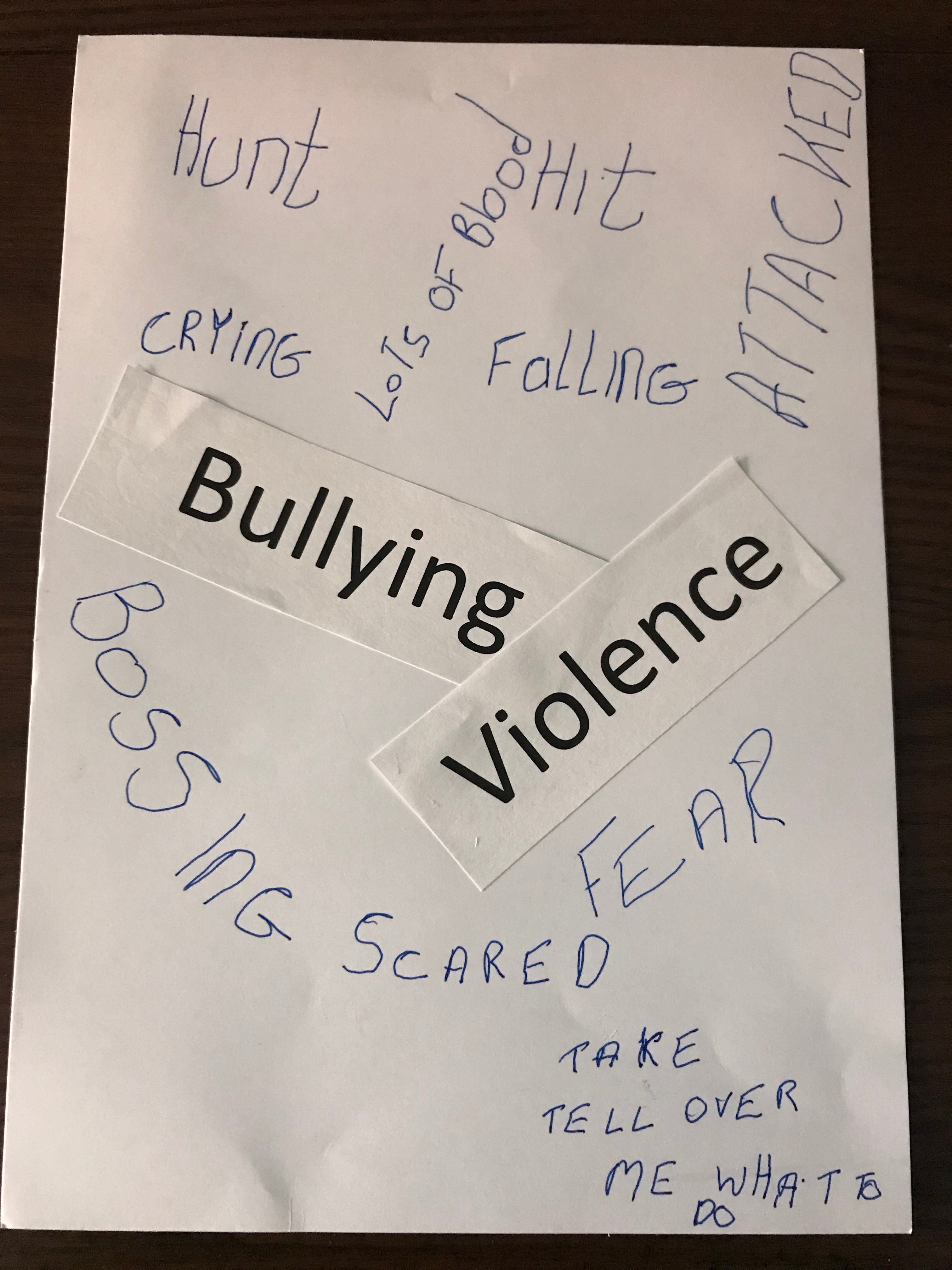
Fifi and Joyce reflected on their past relationships which they described as abusive. In addition to physically beating her, Joyce spoke about the level of control her former partner had enforced upon her. She said, ‘I had a boyfriend and he was bossy. He liked telling me what to wear and what to do.’ Similarly, Fifi said that her ex husband often intimidated her. Elvis and Amanda Depp also spoke about the risk of manipulation, where people would try to take over their lives. When thinking about hate crime then, it calls for more attention to the more intricate and private relationships that people have with others, not simply those that are enacted in public places.

Joyce’s mood board: her mood board includes the words ‘hunt,’ ‘crying,’ ‘lots of blood,’ ‘hit,’ ‘falling,’ ‘attacked,’ ‘bullying,’ ‘violence,’ ‘bossing,’ ‘scared,’ ‘fear,’ take tell over me what to do.’

What does hate crime do?

When participants spoke about their experiences of hate crime, their reflections didn’t simply describe events, but shared a range of meanings attached to these events. More specifically, participants reflected upon how these experiences had, and continued to, make them feel.

Being bullied at work by her boss had made Amanda Depp feel frightened to go into work. The additional workload she was being forced to do had made her so exhausted that she fainted at work. While this was a long time ago, she admitted that she had never been able to get closure from the experience, having not being able to confront her boss.

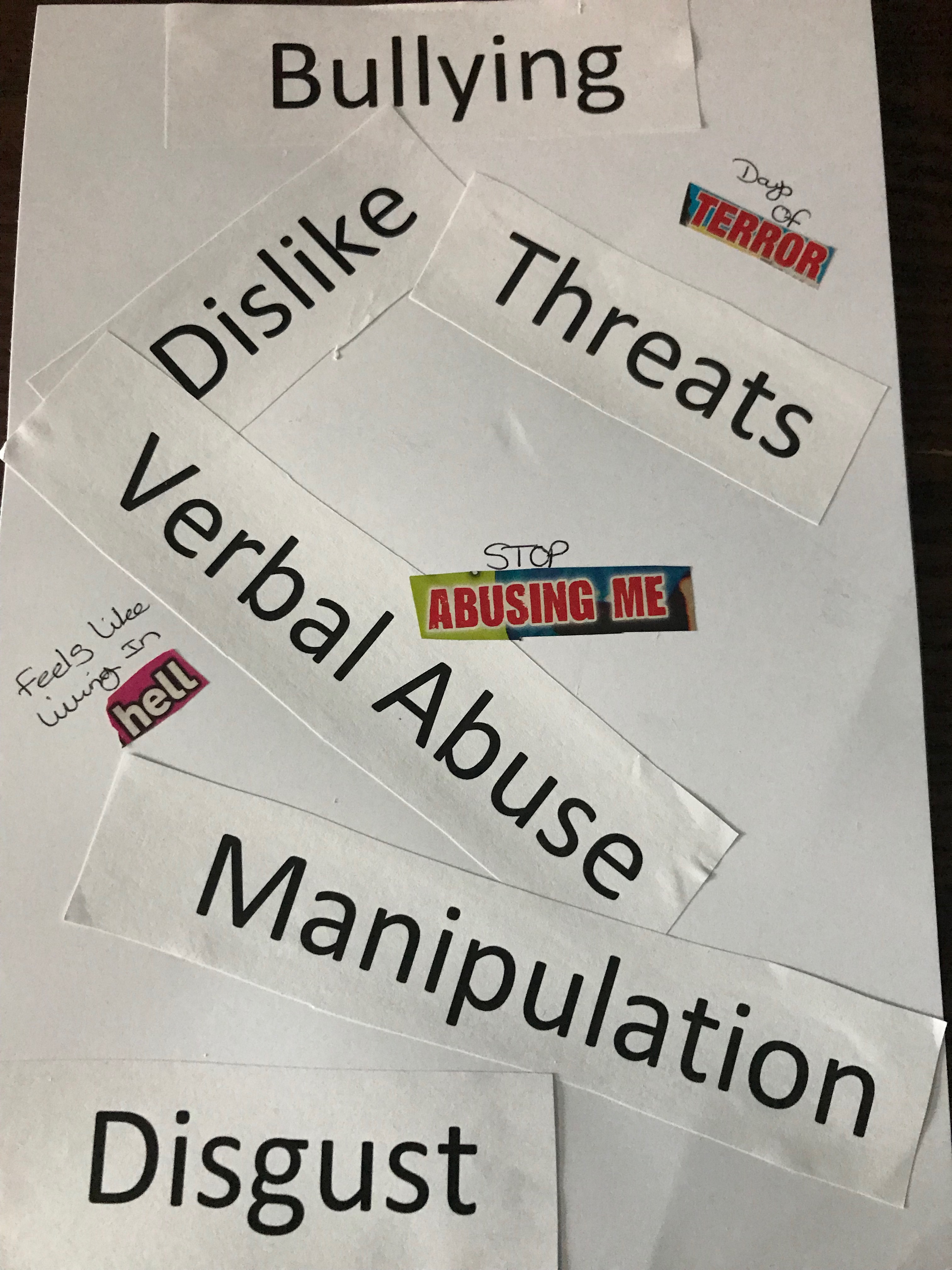
Amanda Depp’s mood board: at the top are the words ‘bullying’, ‘dislike’ and ‘threats.’ She has the words ‘days of terror’ ‘verbal abuse’ ‘manipulation’ and ‘disgust’. She has use cut outs and also her own words to write ‘feels like living in hell’ and ‘stop abusing me.’

Drawing a photo of Judy Finnigan at the centre of his mood board, Elvis was able to speak about his own mental health issues, by relating it to the magazine story on Judy Finnigan. He reflected upon being nervous, losing weight, and being stressed and depressed. He explained:

‘it can effect you growing up and your brain, your mind, because, when you get bullied, it’s going in your mind all the time… you can’t forget what’s happened’ (Elvis)


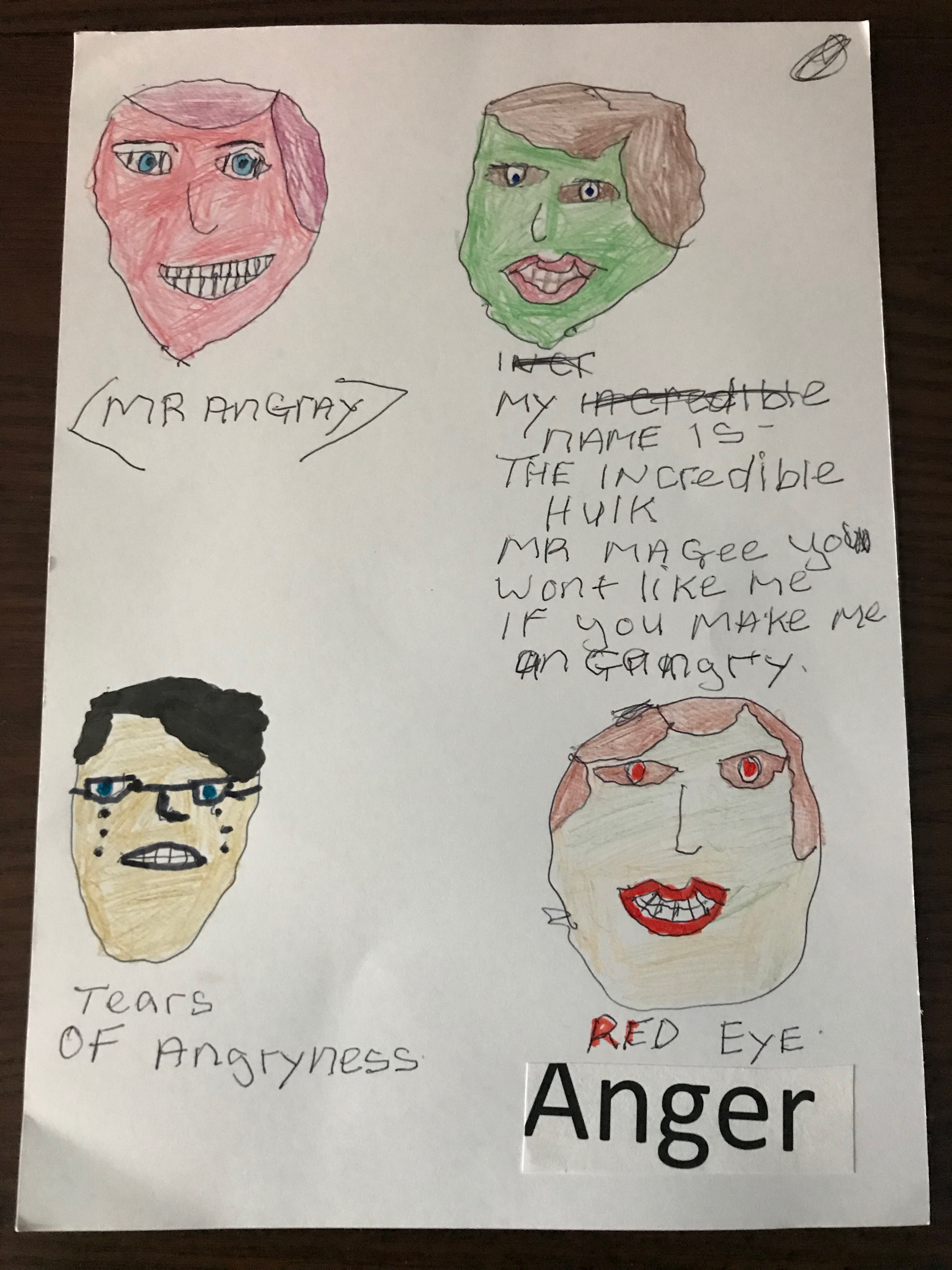
Participants also expressed anger when reflecting upon their experiences. Fifi spoke about the feeling of resentment, and Mary wanted to portray the bitterness she felt towards those who had bullied her during school. Similarly, Sinead said she she felt more frustration than sadness about her experiences. In his mood board, Elvis drew ‘tears of angerness.’

Elvis’ mood board: there are drawings of faces. The first is red and titled ‘Mr Angry.’ The second is green and titled ‘ my name is the Incredible Hulk. Mr Magee you won’t like me if you make me angry.’ The third face is beige, and has tears falling down the face. This it titled ‘tears of angryness’ and the final face is beige but with red eyes and lips, this is titled ‘red eye, anger.’

Negotiating hate crime

Sinead and John Dovet were keen to use the mood boards to express what they thought hate crime was, but to also show how they and others could challenge it. John Dovet suggested that ‘if you put a little but if compassion it helps.’ Sinead spoke about the importance of survival because ‘we didn’t give up despite the fact we were abused.’ On the contrary to giving up, Sinead expressed a significant amount of frustration and anger towards hate crime, and she spoke at length about her desire to challenge those who do not accept her for who she is. While she recognised that ‘they can easily beat me because i’m a girl and disabled’ she also said that his had made her tougher.

For members at Resolve, supporting one another was key for being able to prevent and challenge experiences of hate crime. They spoke about any potential risk they had witnessed in the town centre, and offered each other advice about keeping safe in the community. This demonstrates the value of the collective support that is already enabled through the attendance of organisations such as Resolve, and suggests the need to further harness this for others not currently accessing such services.

For Fifi, separating from her ex-husband had enabled her to focus on herself. She explained:

‘I’ve got everything I need now and as I said before, it was like an open wound and he was, he was being nasty and one thing and another, and I daren’t say boo to a goose. But now i’m getting there, I feel a lot happier, I feel like i’m getting me back now.I know it’s taken years but by crickey it’s hard work, i’m nearly at the top’

Why does hate crime happen?

When beginning to make her mood board, Sinead thought about her own experiences, and some of the reasons she thought she might have been targeted by bullying. She explained, ‘I was born disabled so yeah I think they hated the fact that I was different.’

Participants also spoke about why they in particular might have been targeted by hate crime. John Dovet explained ‘they think they can get away with it because the way they see it, i’m just a pushover.’ Similarly, Amanda Depp explained that she was bullied in work because ‘i’m vulnerable and I wouldn’t argue back.’ She described being bullied by her boss at work, who was also a family friend which made it more difficult for her fight back.

Ideas around vulnerability as an underlying motif of hate crime was returned to throughout the workshop. Developing this further, Bev suggested that older people are more likely to be targeted, as ‘they can’t help themselves.’ However, when referring to bullying at school, participants thought that those who were younger were more vulnerable. Elvis explained ‘as you get older they don’t bully you as much because they go onto another person who’s more vulnerable than you.’

The significance of vulnerability for understanding hate crime is an important consideration given the difficulties that this concept has created in recognising the hostility inherent in such crimes against disabled people.

Cerebral Palsy Midlands: Arts-based workshop

In our first workshop, I asked members to create mood boards that would present their understandings and experiences of everyday hate and hate crime. In a second workshop, we reflected on these mood boards and generated some discussion around the topic of hate crime, and shared some personal experiences. In this blog post, I’ll reflect on some of their mood boards, and draw out some preliminary themes.

Thank you to Daniel, Vinnie, Bob, Violet, Harriet, Gareth, Mickey, Freddie, Andrew, Alice, Tim, and Alex for your fantastic contributions and ongoing support of this project.

Feelings associated with hate crime

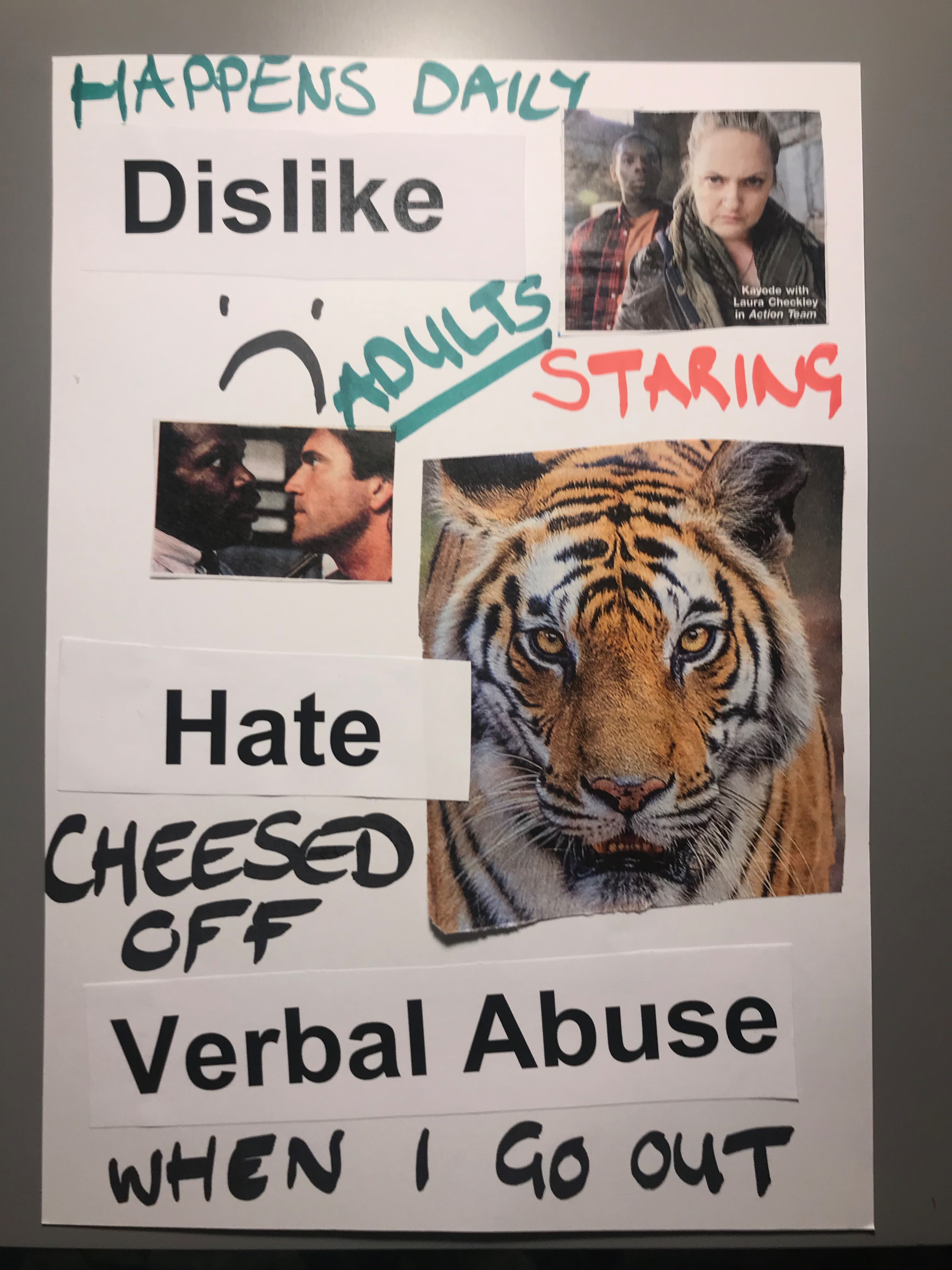
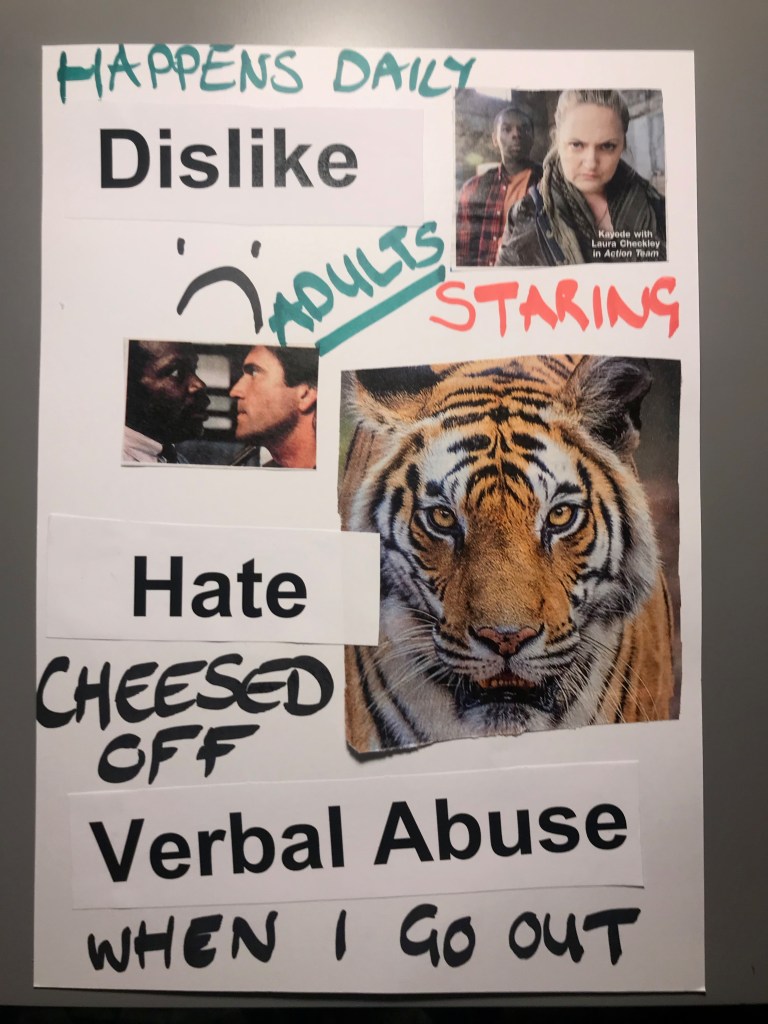
Using her communication board, Violet explained that verbal abuse happened regularly, and that staring in particular happened everyday. This made her feel ‘cheesed off’ and often ruined her days out. Mickey also said that staring and laughing made him feel sad.

Violet’s mood board: the words ‘happens daily’ and ‘dislike adults staring’ are at the top, accompanied by a sad face, and two photos of people staring intensely at the camera, or one another. Below is a large photo of a tiger staring at the camera, next to the words ‘hate’ and ‘cheesed off’. Below is ‘verbal abuse when I go out.’

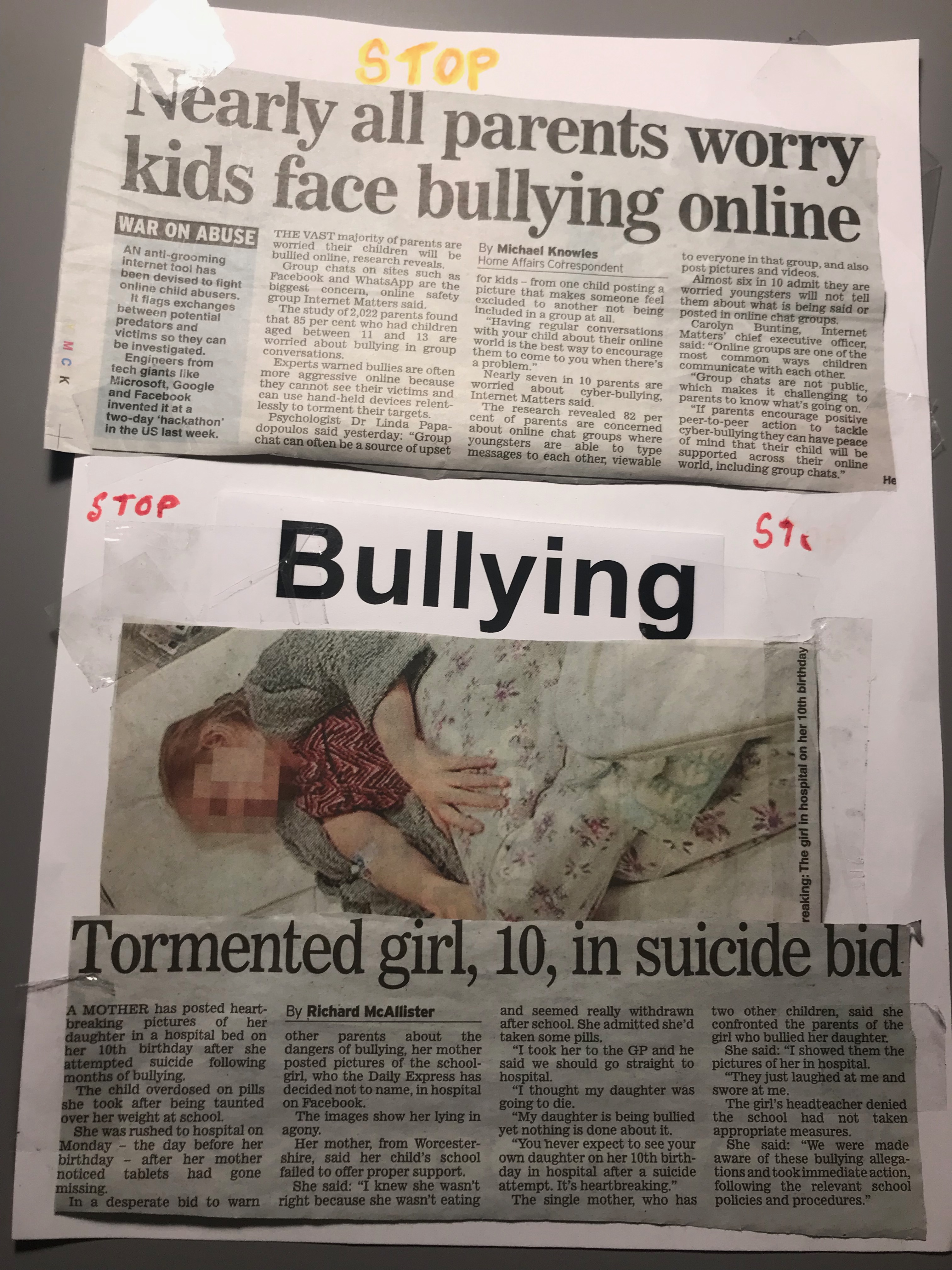
Daniel explained that hate crime could make people feel isolated, and Bob said that it could make you ‘shut the world out.’ In particular, Bob spoke about the ‘torment’ associated with bullying, and how online bullying could increase the risk of suicide for younger disabled people because of how constant it is.

Bob’s mood board: At the top is the word ‘stop’, and below a newspaper headline reading ‘nearly all parents worry kids face online abuse.’ Below this are the words ‘stop bullying stop’ and a cut our photo of a girl lying in a hospital bed. Underneath is a newspaper headline reading ‘Tormented girl, 10, in suicide bid.’

Why hate crime happens

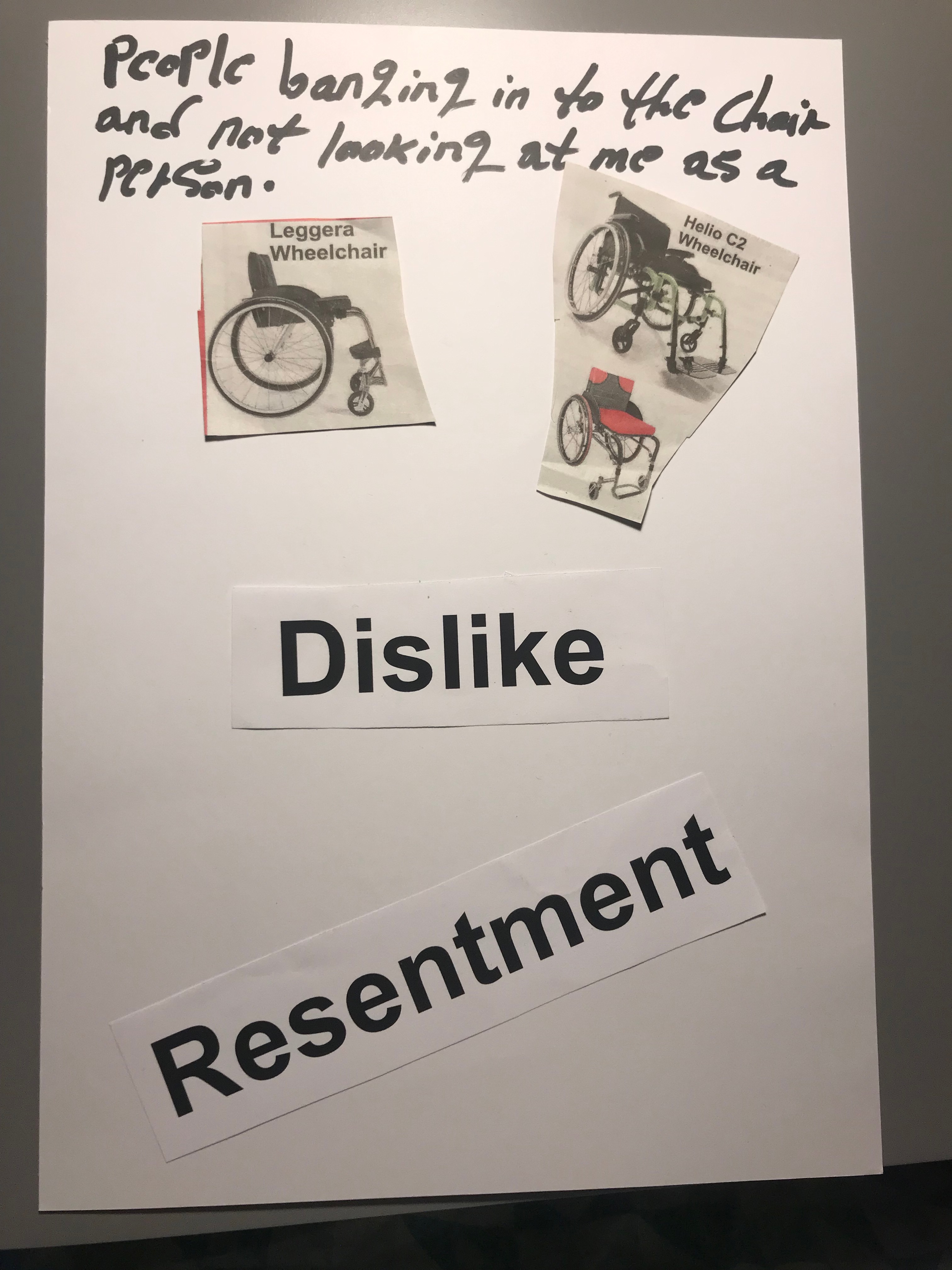
Freddie’s mood board: at the top, text reads ‘people banging in to the chair and not looking at me as a person.’ There are two cut out images of wheelchairs, and the words ‘dislike’ and ‘resentment.’

When making sense of hate crime, Freddie reflected on his own experiences of being a wheelchair user, and how this caused people to think differently about him. While he valued his wheelchair as ‘part of who I am,’ he also noted that people would bang into his chair and ‘not look at me as a person.’

Many members also spoke about the importance of vulnerability. Vulnerability was suggested as a outcome associated with being targeted by hate crime (Alex) but many members also spoke about their own vulnerability to be targeted.

Bob suggested that people might think disabled people are ‘easy to get to’ and can’t defend themselves, which made them vulnerable to being a target of hate crime. Alex and Vinnie also thought vulnerability was important.

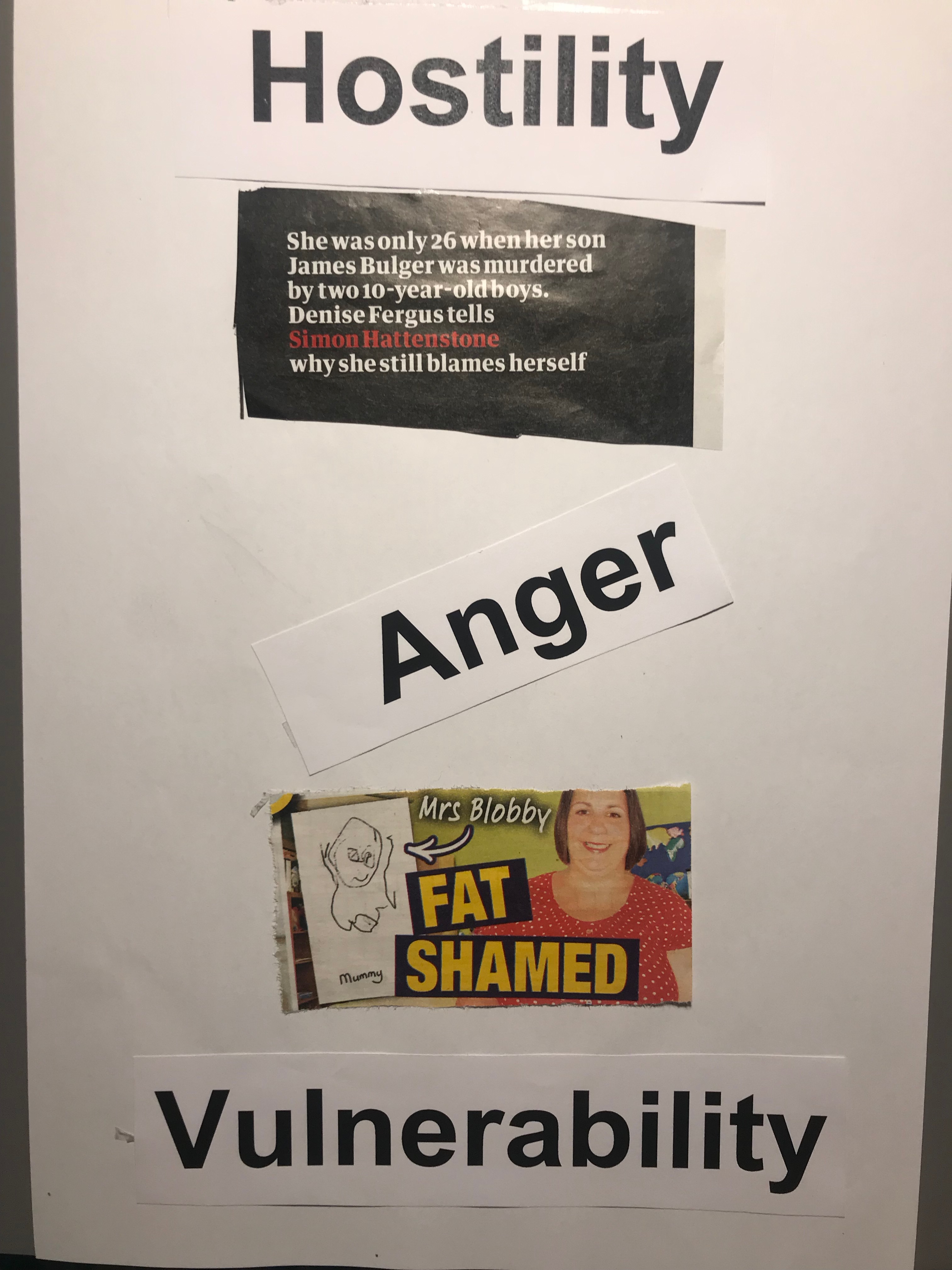
Mood board by unknown. At the top is the word ‘hostility’ and below is a newspaper clipping about the murder case of James Bulger. Underneath is the word ‘anger’ and a cut out photo of a women next to the headline, ‘fat shamed.’ At the bottom of the page is the word, vulnerability.

Attitudes towards disabled people were also suggested to be important. In particular, Daniel thought about people ‘not being accepted for who they are.’ Joe explained, ‘they see disabled people and they think that we’re stupid’ followed by Alex who said that ‘they think we’re stupid, dumb, thick, you name it.’ Developing this discussion further, Alex explained that derogatory language such as ‘mongrels’ was normal to society, because ‘they don’t think we deserve to be on this earth.’ Bob suggested that this language in particular was problematic, because ‘you hear it all around school.’

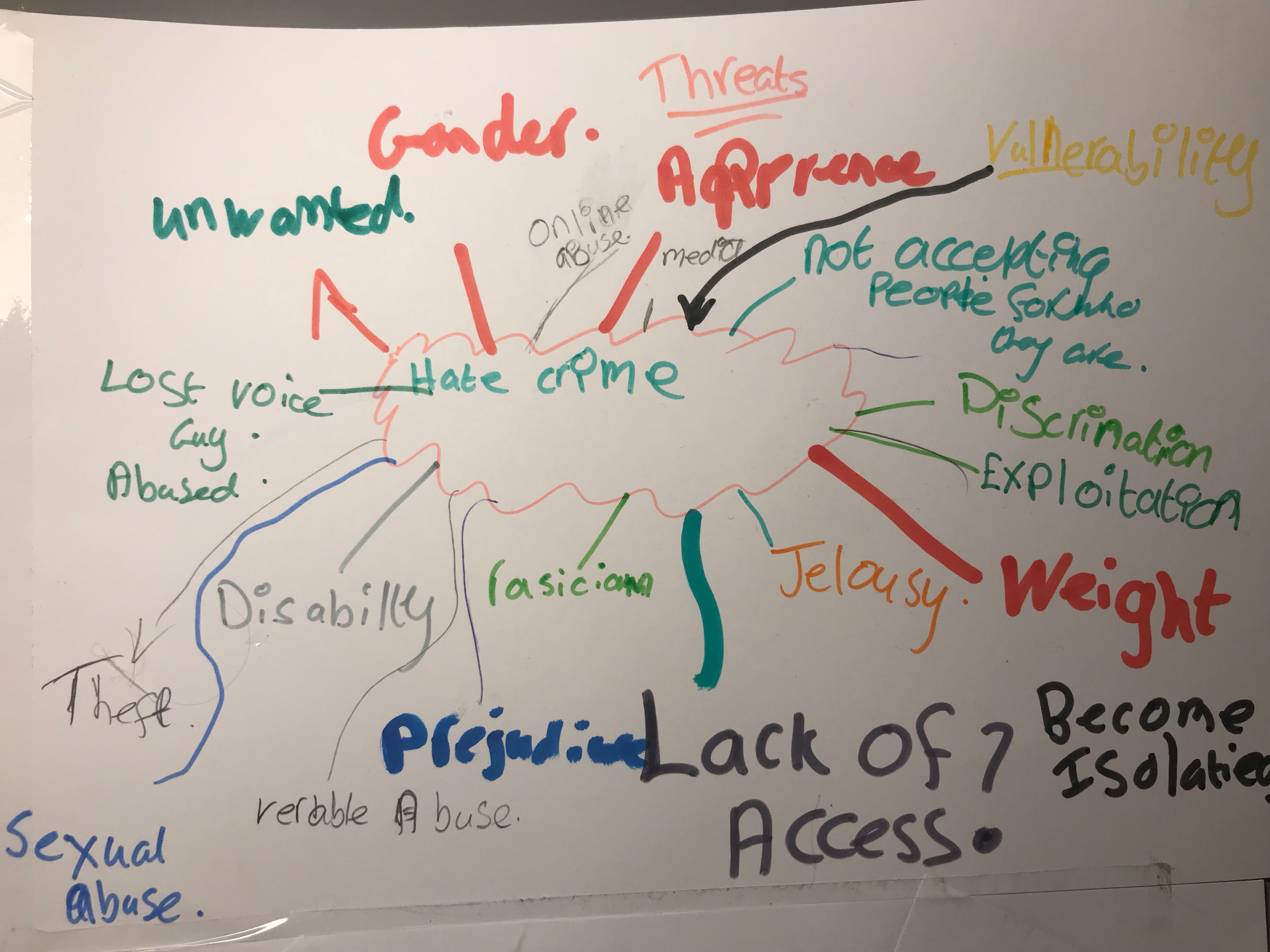
Gareth and Daniel’s mood board: This is a concept map with hate crime in the middle, and the following words around the outside: threats, appearance, media, vulnerability, not accepting people who who they are, discrimination, exploitation, weight, jealousy, become isolated, lack of access?, racism, prejudice, verbal abuse, disability, sexual abuse, theft, lost voice guy abused, unwanted, gender, and online abuse.

Challenging hate crime

Alex was particularly keen about using the mood boards as tools to educate other people about disability hate crime, especially politicians. He argued ‘we need to make people more aware of, we shouldn’t be told to shut up we should be told we can speak out.’ He explained that we need better policies in place, and that the mood boards could be a way of making a ‘statement.’ While agreeing that we needed to stop hate crime, Vinnie argued that we should focus on motivation and prevention. In particular, he was wary of political support, questioning ‘why should we go to the extreme when the government looks at us and takes he piss out of us? They’ve been abusing us, and the authorities, for years.’

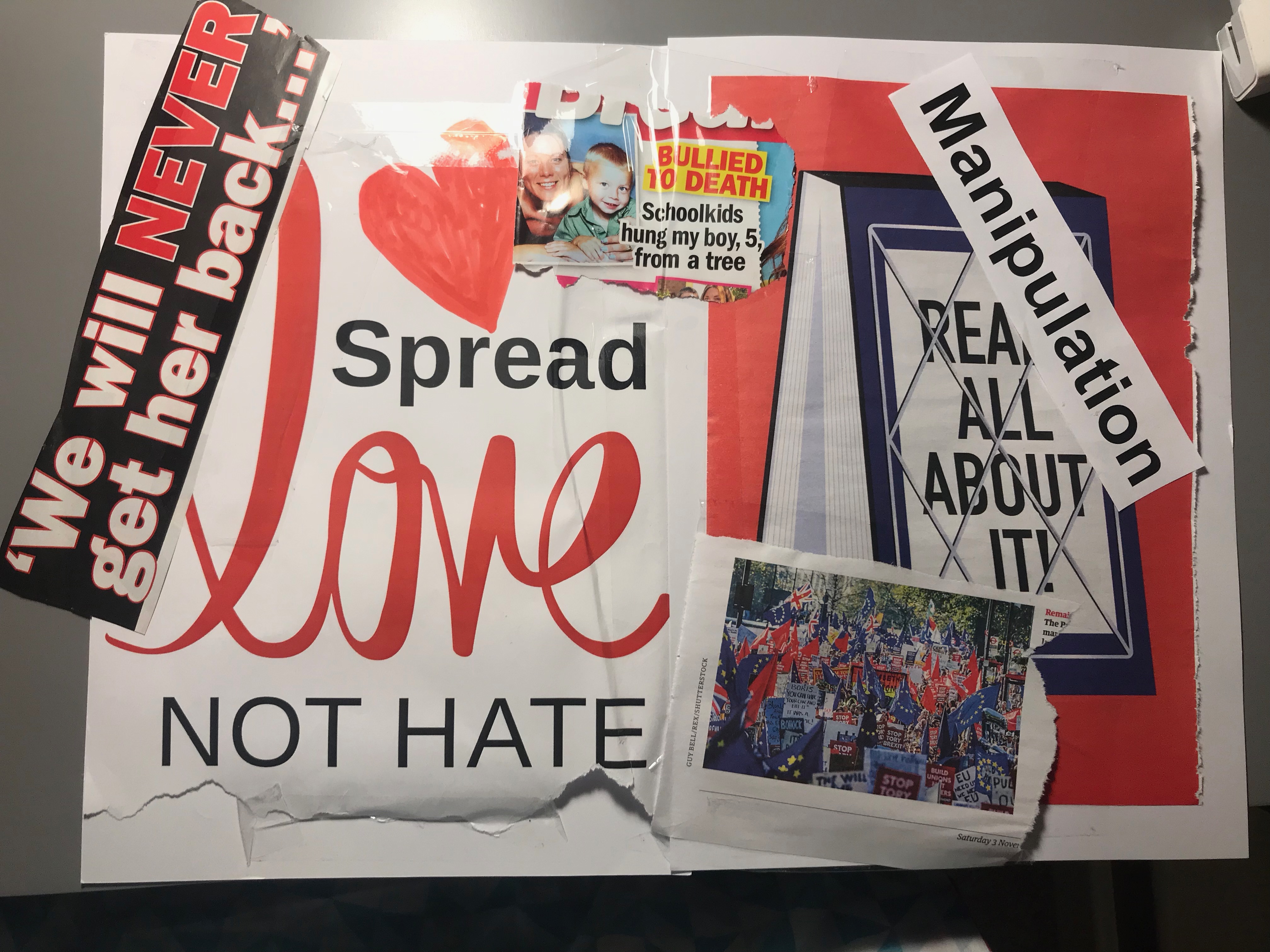
Alex’s mood board: the first cut out reads ‘we will NEVER get her back…’. Next to this is a large print cut out reading ‘Spread love NOT HATE’, and a drawn red love heart. There is a cut out with a picture of a child and a headline reading, ‘bullied to death.’ On the right side, there is a large cut out reading ‘read all about it!’ the word manipulation, and a photo of a protest with a large banner saying ‘Stop Tories.’

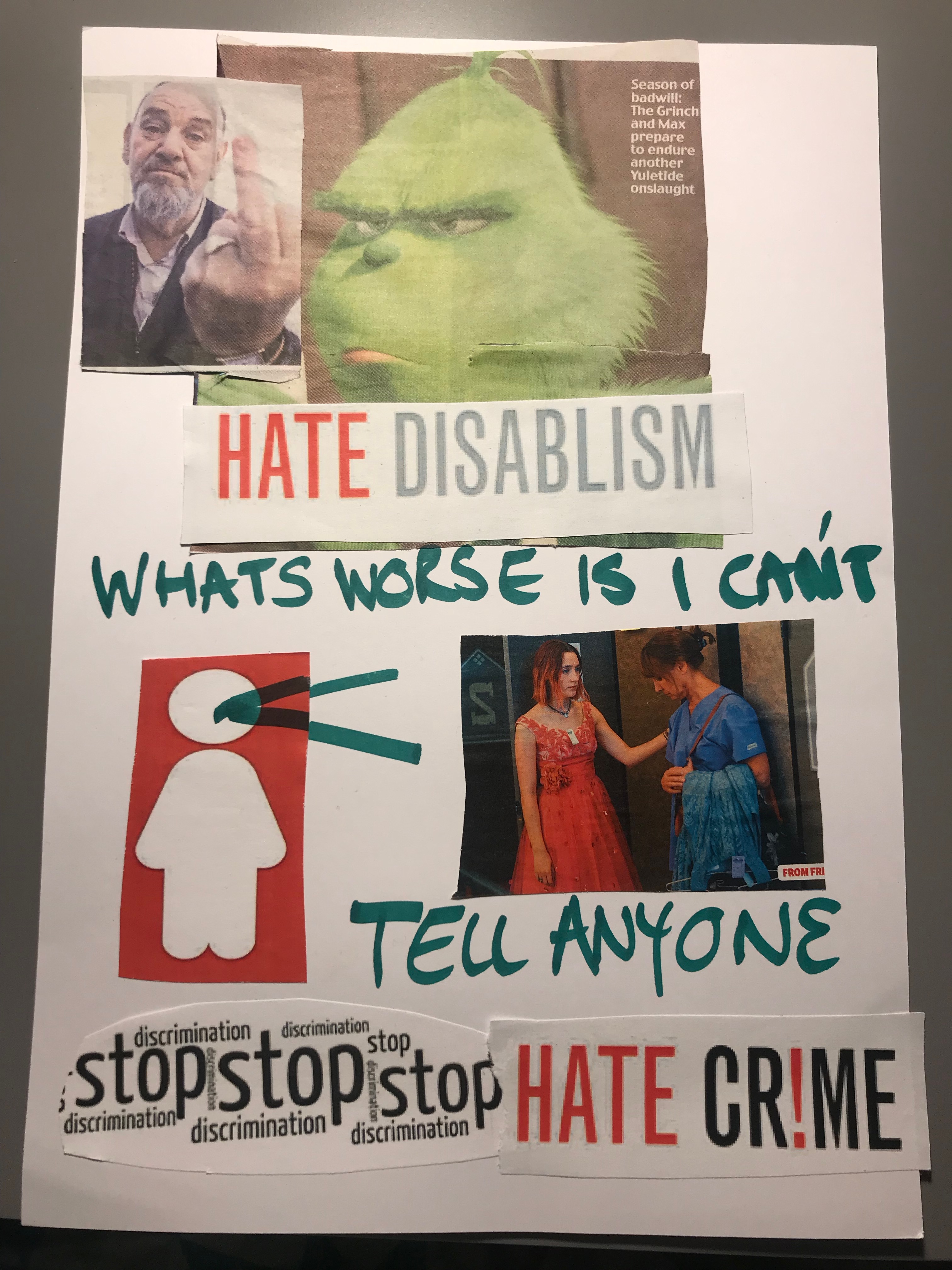
For Violet, one of the worst things about experiencing hate incidents, such as staring, on a daily basis is that she can’t tell anyone. Violet uses a communication board, and therefore finds it challenging to negotiate hateful experiences as they happen. She agreed with a staff member’s suggestion that a big button on her wheelchair that told people to stop staring would be very useful.

Violet’s mood board: at the top are two cut out pictures. The first shows a man sticking his middle finger up at the camera, and the second is a photo of the Grinch scowling. Underneath are the words ‘hate disablism’ and ‘whats worse is I can’t tell anyone.’ There is a cut out of a white silhouette person, with an arrow pointing to its head, and also a photo of two people supporting each other. At the bottom, are the words ‘stop, stop, stop’ and ‘hate crime.’

It was not just difference in communication that could make hate crime incidents difficult to challenge. The assumption of vulnerability discussed above suggests that, as Bob states, disabled people are seen as ‘easy targets.’ This is similarly felt by Gareth who, reflecting upon his own experience, said that he would not be able to defend himself.

Where hate crime happens

When thinking about where hate crime take place, Alex suggested that it ‘could happen anywhere.’ Some specific suggestions were public transport, with one member reporting that they were robbed and beaten up in a taxi. Joe and Alex discussed the difficulty of accessing buses in their wheelchairs, particularly as people wouldn’t want to give up their seat. As a result, Joe said that he had been shouted at before in this situation. Members are suggested that hate crime could occur in more private spaces, such as care homes (Alex) and our own homes (Joe)

Final thoughts…

A huge thank you to CP Midlands for their ongoing support in the project, and especially all members who have been involved so far. Our workshops have identified a number of key things to think about moving forward, in terms of how we understand, experience and respond to hate crime.

Arts-based methods: Workshop 2 with Leep1

In my second workshop with members at Leep1 we incorporated arts-based methods as a means of sharing and representing understandings and experiences of hate crime. I asked members to create ‘mood boards’ and we reflected upon these together throughout the workshop. In this post, I’d like to share some preliminary reflections, drawing upon the conversations we had, and the mood boards produced.

Thank you to all members who were involved in this workshop, including: Arjun, Samir, Caitlin, Terry, Sabrina, Michael and Jenny.

Understandings of hate
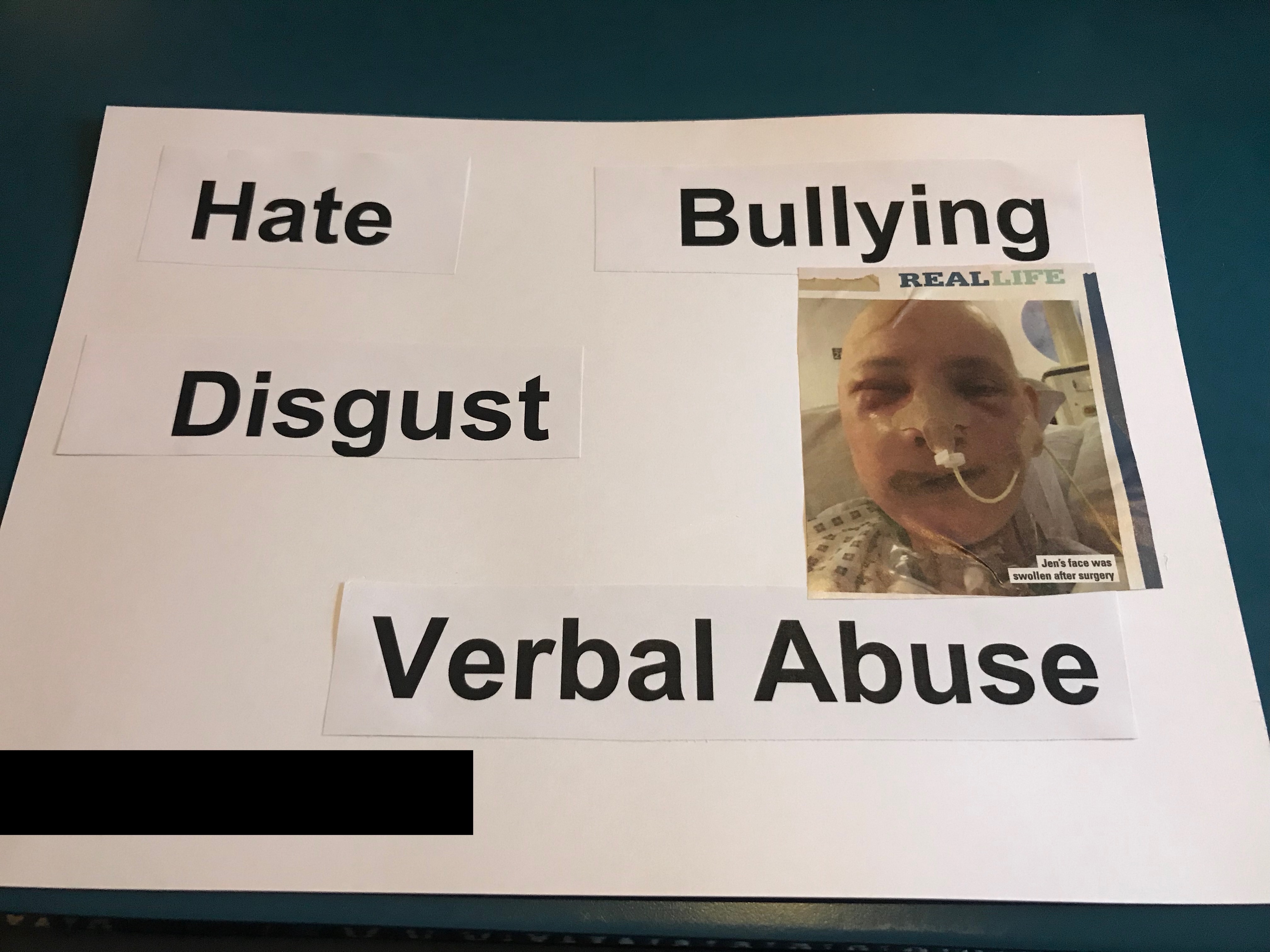
Following on from our previous workshop, members continued to describe hate crime as ‘bullying’ and many chose to present this through images of physical violence (See Terry’s mood board below).

Terry’s mood board: It has the words ‘hate,’ ‘bullying,’ ‘disgust,’ and ‘verbal abuse.’ There is a photo of a person with a swollen face and bruised eyes, with tubes on their face.

Hate crime was also understood to include sexual abuse (Sabrina), verbal abuse (Michael), death threats (Caitlin) and violence (Michael).

The values and risks of media
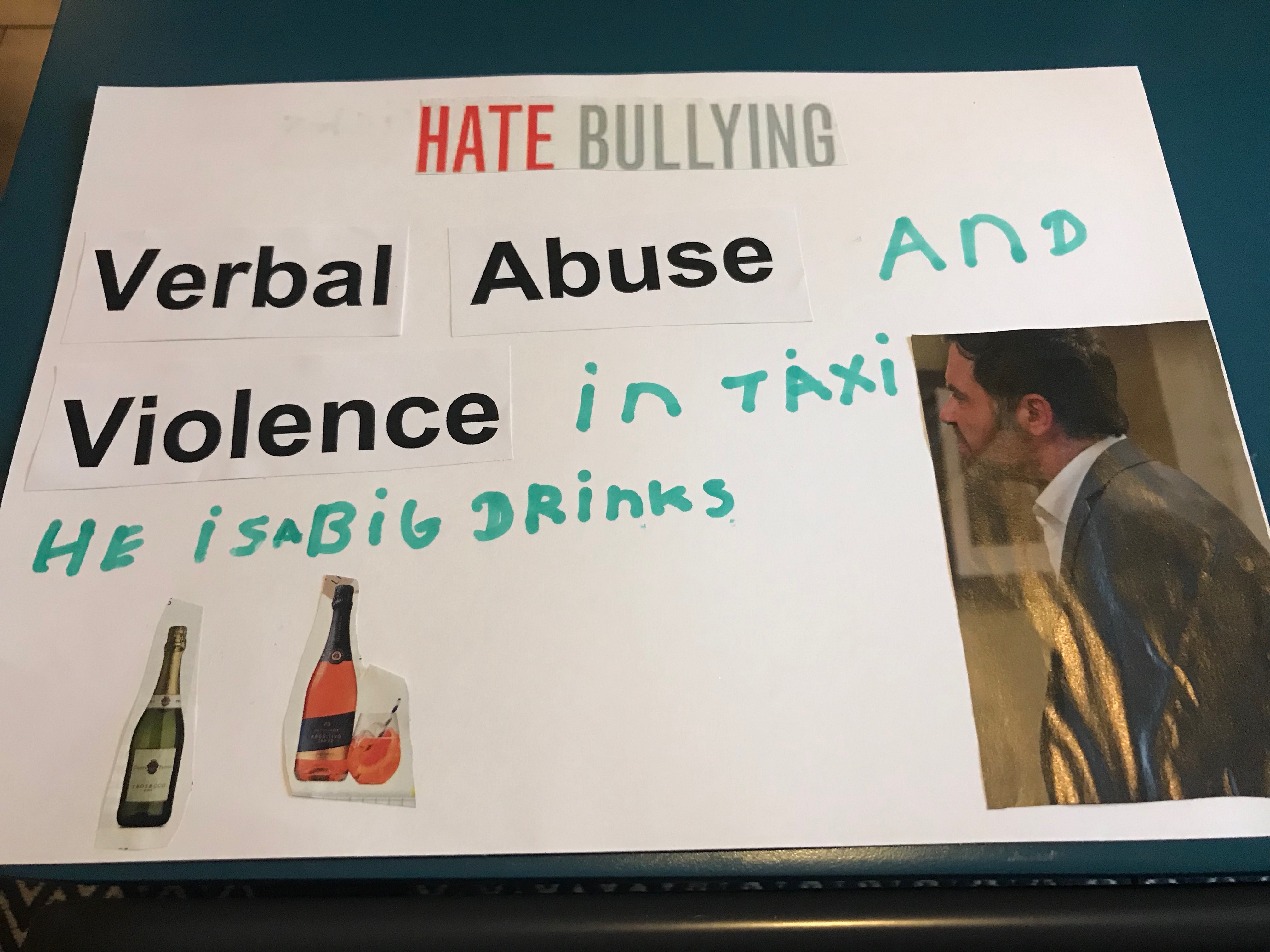
Some of the magazines that I had provided as possible resources for images and words for TV Guides. For Michael, these cultural artefacts provided a means of thinking about his own understanding of violence, and the different forms this could take. Specifically, he drew upon storylines in Coronation Street and Emmerdale, as they were presented in the TV Guides. He explained that Graham, from Emmerdale was a bully, while Sally from Coronation Street was being bullied, explaining ‘Sally is being bullied, she’s not guilty because she did not do the deed’ (See Michael’s mood board below).

Michael’s mood board: It has the words ‘hate bullying’ at top. The text reads ‘verbal abuse and violence in taxi’ and ‘he is a big drinks.’ There are 2 photos of bottles of alcohol, and a photo of the character Graham from Coronation Street.

Sabrina also discussed soap storylines, and referred to Hollyoaks which had recently aired a story around the issue of sexual assault. This was a particularly important story for her.

This presented a whole new means of understanding hate crime that I had not considered before these workshops. While I imagined the magazines would provide useful images and words when making the mood boards, I had not realised the educational potential that could be gained by reflecting upon TV storylines.

The educational potential of TV representation is twofold. While it can present the contextual basis to educating about real-life issues, it equally shapes our understandings and assumptions of real people. Members were critical of media representations. For example, Sabrina explained that programmes like Channel 4’s ‘The Undateables’ made her angry because it reinforced for others, that disabled people are not ‘normal people.’ Michael explained that this show resulted in an increase in prejudice towards disabled people.

Feelings associated with hate crime
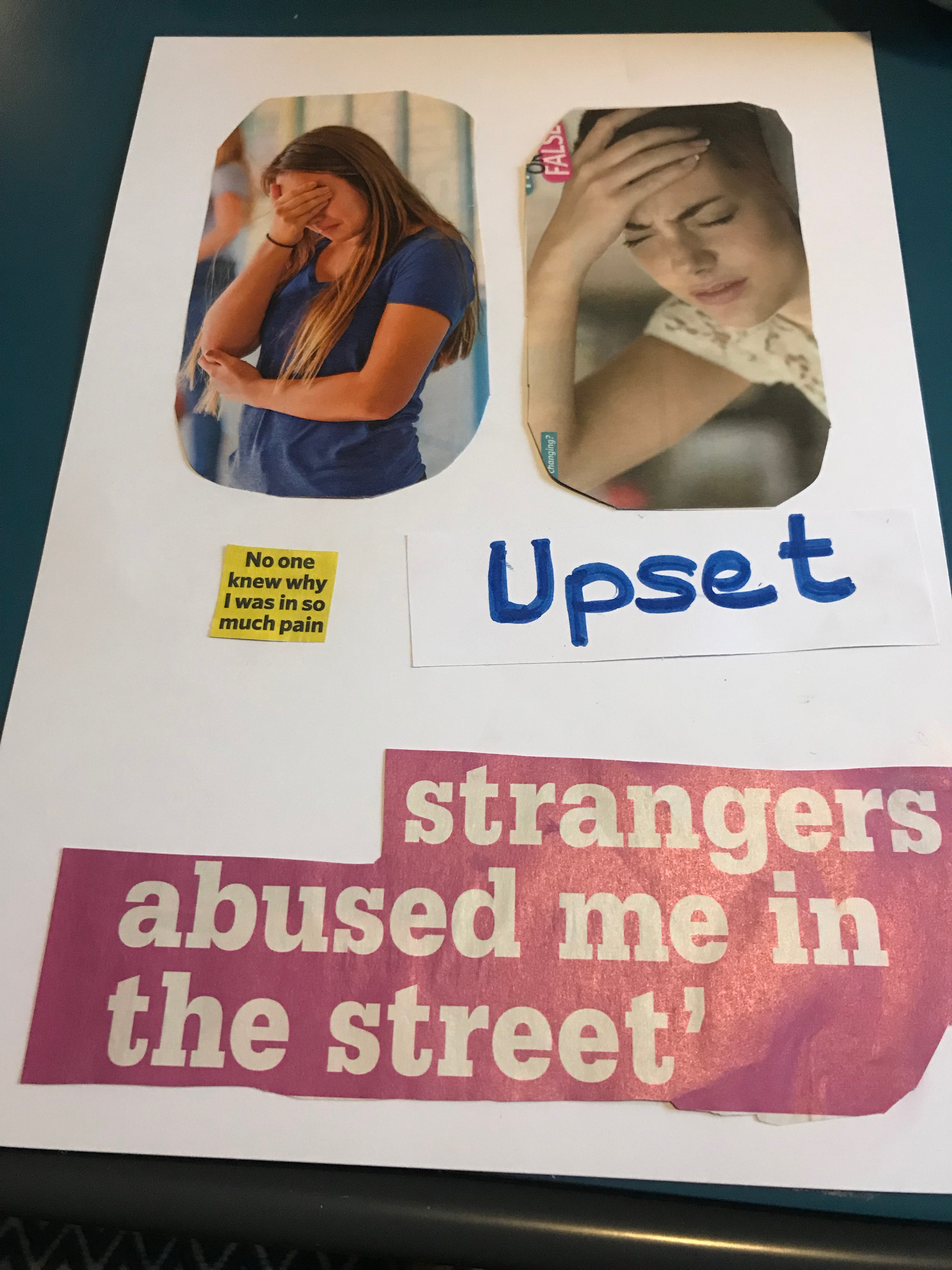
Like our previous workshop, members still found it difficult to describe exactly what they thought hate crime was. However, they found it much easier to present the feelings and harms that they associated with it. Arjun looked for photos of people looking upset, and described that it made people ‘not feel good’ (See Arjun’s mood board below).

Arjun’s mood board: this has two photos at the top of the page both showing women looking upset, with their hands on their head. Text includes ‘no one knew why I was in so much pain,’ ‘upset,’ and ‘strangers abused me in the street.’

Caitlin explained that hate crime and sexual abuse had made her ‘freeze’ and Samir said that he would feel ‘very scared’ if he was to be a victim of hate crime.

Members also spoke about the long-lasting harms that were felt after experiencing hate crime. Upon reflecting upon her own experiences of sexual abuse, Sabrina said ‘it’s messing with my head again, I don’t know why’ and asking if it was because of ‘anger.’

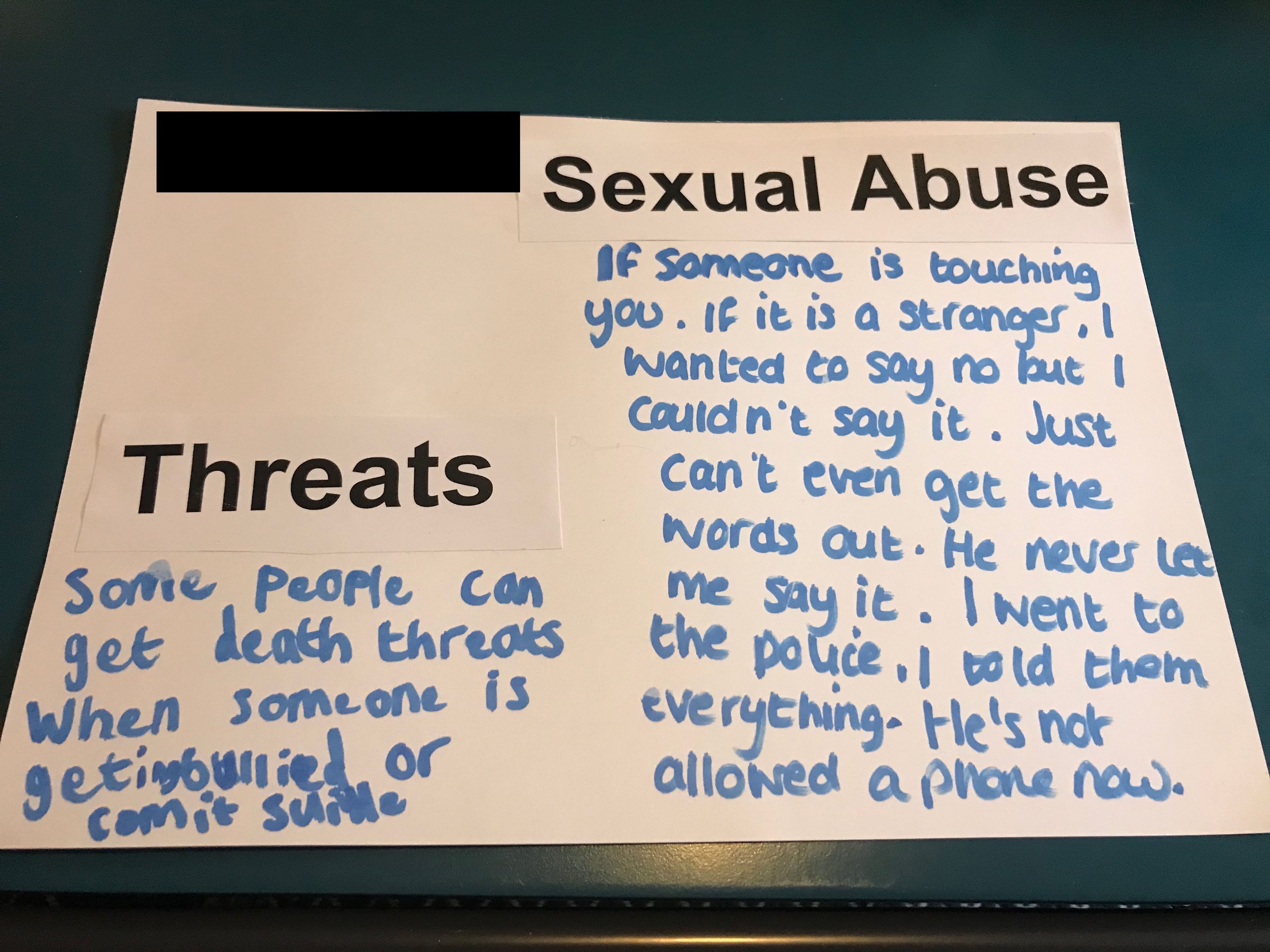
Caitlin’s mood board: this is text based and is split into two sections. On the left, the heading reads ‘threat’s with the following text ‘some people can get death threats when someone is getting bullied or comit suicide.’ On the right, the heading reads ‘sexual abuse’ and the text below ‘if someone is touching you. If it is a stranger, I wanted to say no but I couldn’t say it. Just can’t even get the words out. He never let me say it. I went to the police, I told them everything. He’s not allowed a phone now.’

Caitlin found it difficult to present these harms on her mood board, but was really keen to still share her experiences with others. Rather than use images, she chose instead to write about her experience, which was about sexual abuse (See Caitlin’s mood board to the right).

Challenging hate crime
Members at Leep1 are actively involved with a number of projects and activities which aim to raise awareness of a variety of disability related issues. Many of the members are involved in drama performances within schools in order to teach young people about disability hate crime. In my previous blog post, I wrote about Sabrina’s reflections on the importance of these kinds of projects.

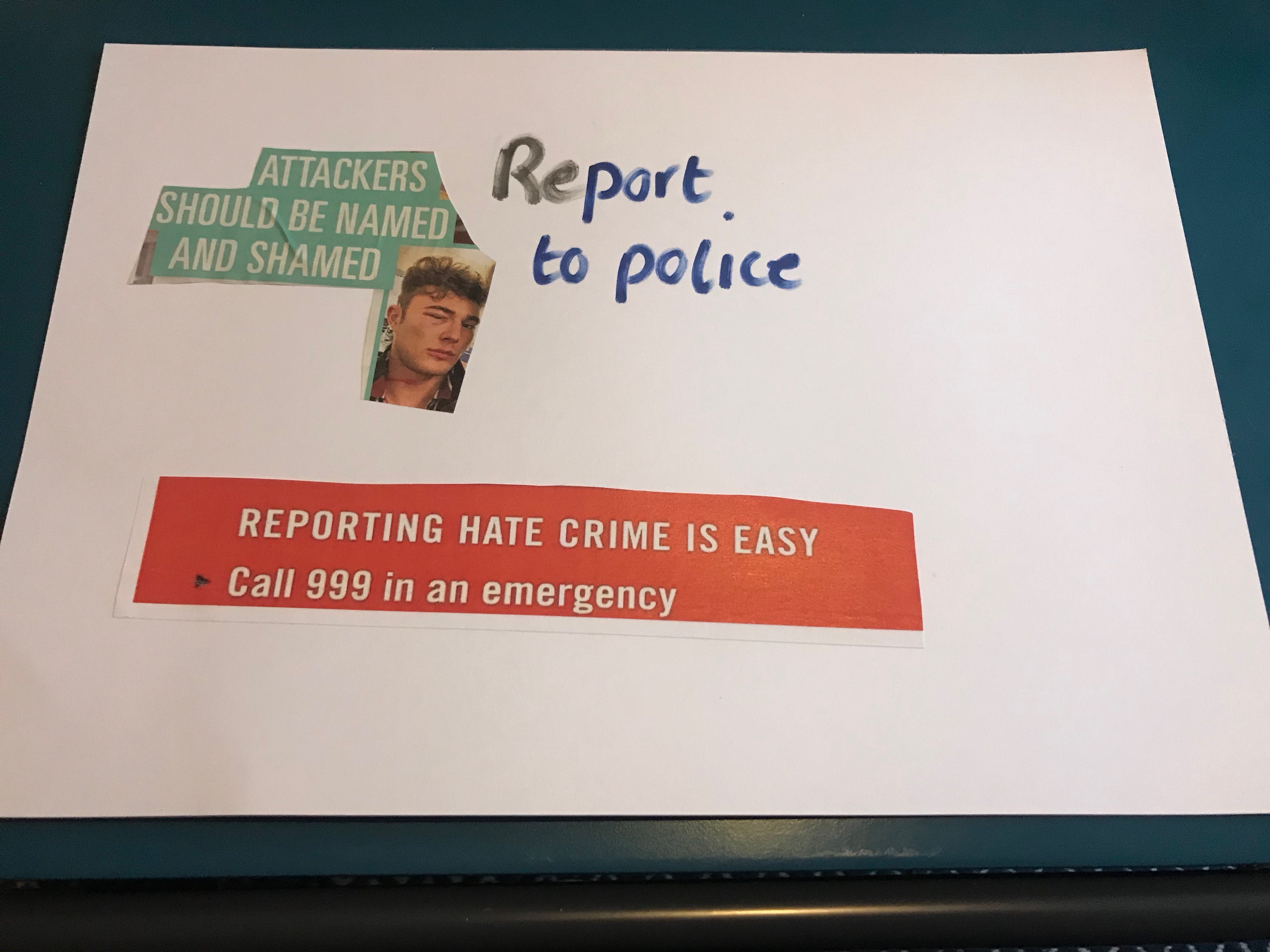
In addition to this, there were more implicit approaches to challenging hate crime that members presented. Jenny chose to focus on the importance of reporting hate crime, and educating others about how easy this could be. For her, reporting was important to ensure that people who committed hate crimes faced the appropriate consequences, and being ‘named and shamed’ (See Jenny’s mood board below)

Jenny’s mood board: text reads ‘report to the police’ which is next to a photo of a young man who has a bruised face. There are sections of text cut out from magazines reading ‘attackers should be named and shamed’ and ‘reporting hate crime is easy, call 999 in an emergency.’

Members also spoke about the value of ‘speaking out’ (Sabrina) and sharing experiences with others.

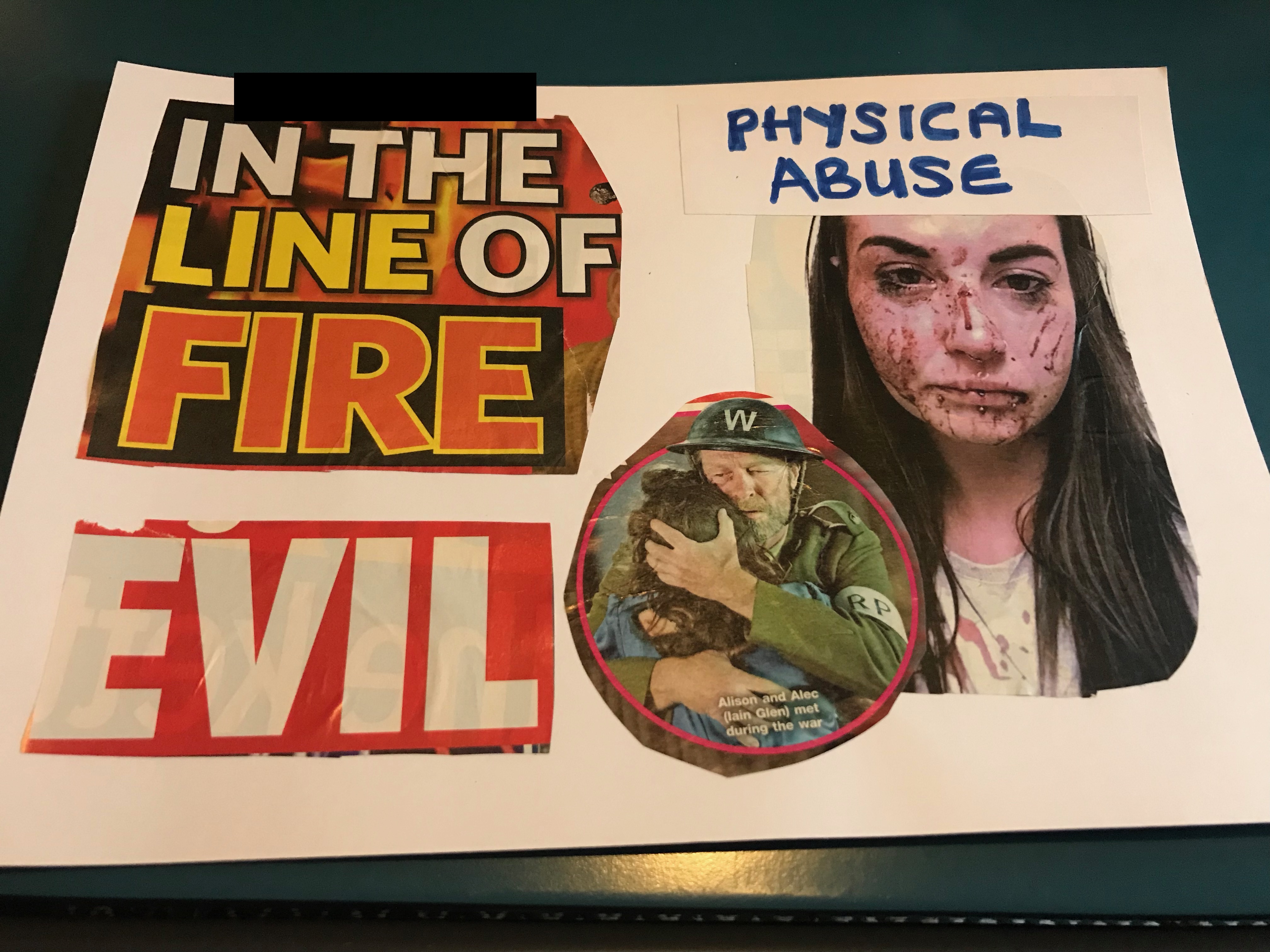
Samir’s mood board: this has a large cut out of text reading ‘in the line of fire’ and ‘evil.’ It has the words ‘physical abuse’ above a photo of a girl that has bruises and blood on her face. There is also a photo of a man comforting a woman while holding her.

This built from our previous discussion, where members described the emotional harms of not being able to talk about our experiences. Samir presented the comfort that could be felt when disclosing our experiences and feelings to those close to us (See Samir’s mood board to the right).

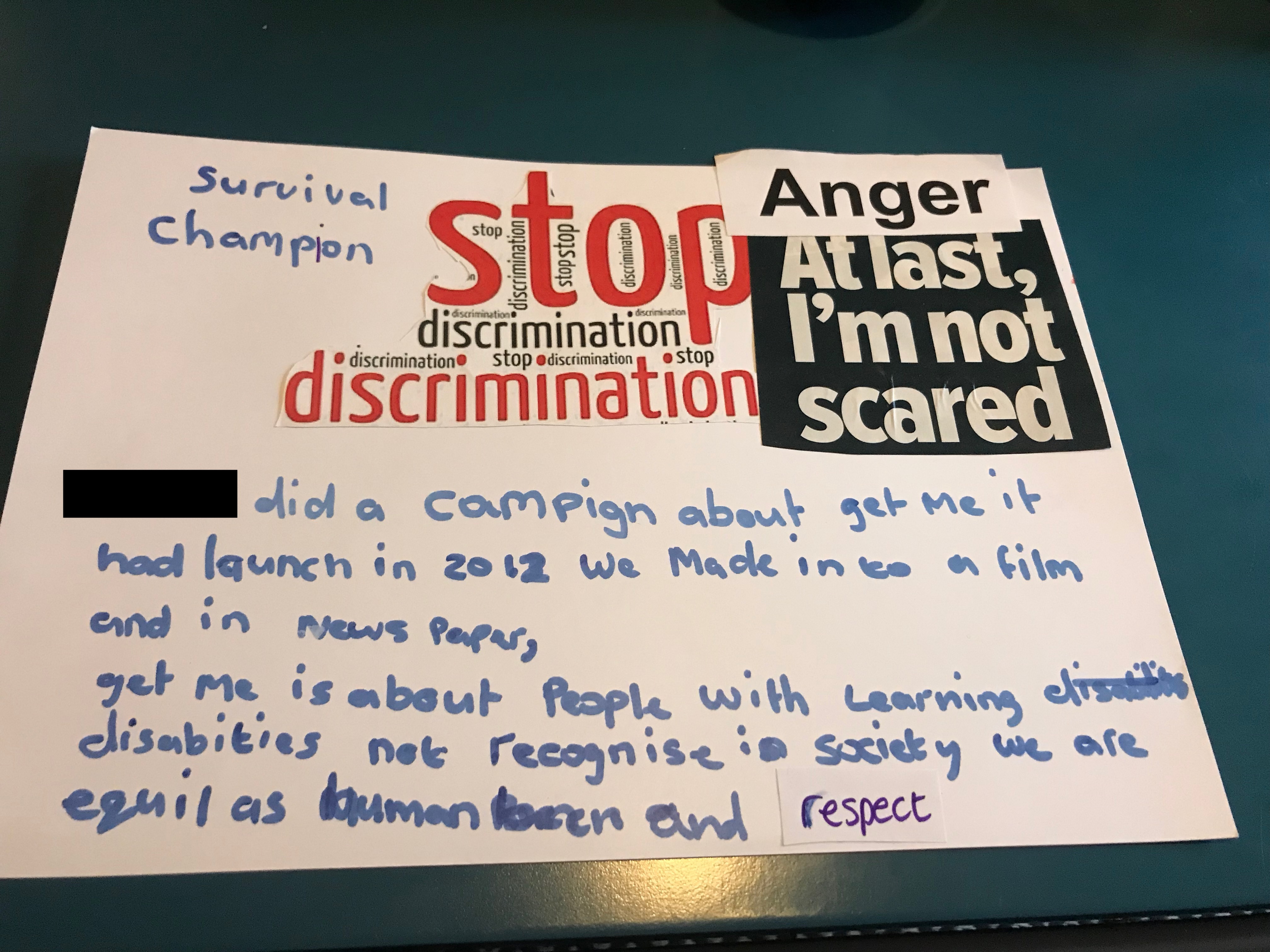
When discussing the importance of speaking out against hate crime, Sabrina spoke about her own use of using the media in order to raise awareness about disability-related topics. She explained with pride about a campaign she had been involved with called ‘Get Me’ which aimed to teach others about disability, and to recognise disabled people as equal human beings in society. For Sabrina, her engagement with these projects represented her ‘survival’ (See Sabrina’s mood board below).

Sabrina’s mood board: this has the words ‘survival’ and ‘champion.’ In the centre is a cut out that reads ‘STOP discrimination’ along with ‘anger’ and ‘at last, i’m not scared.’ Below Sabrina wrote ‘Sabrina did a campaign about get me it had launch in 2012 we made into a film and in newspapers, get me is about people with learning disabilities not recognise in society we are equil as human beings and respect.’

Reflections
Using arts-based methods opened up the opportunity to reflect upon the meaning of hate crime together. Images and words enabled members to produce meaningful representations of what hate crime meant to them, and to discuss any experiences that they wanted to share. We were able to collaboratively construct our understandings of hate crime as members created their mood boards, and explained why they were choosing to present certain images or messages.

Discussion-based workshop with Leep1: some early reflections

In this first workshop with Leep1, we discussed a range of ideas about what hate crime means. We spoke about the meaning of ‘hate,’ shared examples of hate and hate crime, and reflected on what feelings were associated with experiencing this. In this post, I am sharing some of my early thoughts on this workshop and the ideas shared. All images used below have been produced by ‘easy on the i’ as part of their work supporting the production of easy read documents.

Huge thank you to (all anonymized) Arjun, Samir, Caitlin, Terry, Billy, Sabrina and Michael for your fantastic contributions and support for this project!

What is a hate crime?
Members suggested that it is difficult to define what a hate crime is, and to recognize examples and experiences of this. When asked to describe it, Billy, Samir, Arjun, and Sabrina explained that hate crime meant ‘bullying’ and Sabrina and Samir said that an example of this was ‘picking on people’. They also recognized that hate crime could happen for a lot of reasons, and be motivated by different identities, such as religion, disability, and race.

Image shows two people, one is pointing and looks angry. The other looks upset. The image is captioned ‘bullying.’

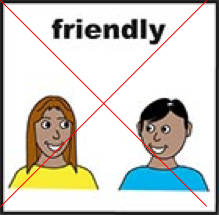
Many members discussed their understandings of ‘mate crime’ and how this was slightly different to hate crime. It seemed to be very important for the members that people with learning disabilities were aware of what mate crime is. Caitlin, Terry, Billy, and Sabrina explained that mate crime was about ‘fake friends’.

This image shows two people looking at each other smiling and it is captioned ‘friendly.’ There is a big red cross over this image.

Sabrina explained that people who committed mate crimes did it for their own ‘personal gain’ and that people with learning disabilities are targeted because they are ‘not being recognized in society,’

How does hate crime make you feel?
Although it was difficult to define exactly what a hate crime is, members found it much easier to talk about how it made them feel. Michael said it made him feel ‘angry’ and ‘heartbroken’ and Billy spoke about it sending him into a ‘mad temper.’ This feeling of anger was something that members agreed with.

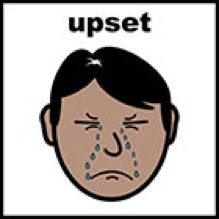
Michael explained that hate crime made him feel ‘stressed’ and ‘frightened’ and Arjun said that it ‘upset’ him.

This image shows a photo of a person crying, and is captioned ‘upset.’

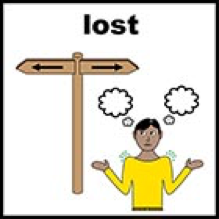
Sabrina and Caitlin also spoke about experiences of sexual abuse, which they understood to be related to hate crime. These experiences had made them feel ‘shaky,’ ‘frozed,’ ‘lost,’ and ‘dirty’ (Sabrina). Caitlin also described a process of ‘grieving’ following her experience, suggesting the long-term impacts that hate crime and sexual abuse can have.

The image has a sign with arrows in different directions, and a person holding their arms out in confusion. The image is captioned ‘lost.’

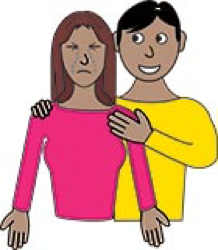
Members explained how important it was to talk to others about their experiences of hate crime. Billy explained that it could upset you more if you don’t share, and Sabrina described how it could make you poorly ‘if you hold it in.’ Members, in particular, spoke about the importance of being part of Leep1. Michael described it as a safe space, and Billy said that it was a space where ‘your friends can help you out.’

This image shows a person being comforted by their friend.

Managing and Resisting Hate Crimes
Members discussed some of the different ways they could deal with hate crime if it happened to them in the future. Although Michael explained that sometimes it was easier to just ignore incidents and move on, he also said that you should still talk about it with others. In particular, he spoke about being able to tell the bus driver if you were being bullied on the bus, or talking to staff at Leep1. Sabrina also said that you could talk to teachers if the incident happened at a school, and Billy said that you should speak to the police.

Members also explained about an initiative called ‘safe spaces.’ These are places in the city centre of Leeds and other cities where you can go if you feel ‘vulnerable’ or are being bullied (Sabrina). While these were good, Billy spoke about the lack of these ‘safe spaces’ at a night time, which could result in many people avoiding being out during these times.

Members’ resistance to hate crime was evident in their involvement with campaigning and work within schools. Many of the members were part of a drama group, and would hold performances about hate crime and mate crime at schools. This was important for Sabrina, as the use of body language meant that ‘it comes out very strong and stands out.’ There are clear educational gains from these types of initiatives.

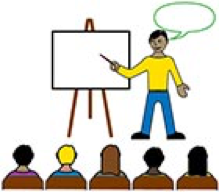
This image shows a person teaching a group of people. The person is pointing to a whiteboard.

The Ongoing Process of Getting Started with Fieldwork

I am mid-way through the second year of my PhD, and thoroughly enjoying being immersed within my fieldwork. I have conducted a number of workshops and just started the interviews. In this post, I’d like to reflect upon the earlier stages of fieldwork and in particular, the lengthy process involved with getting the fieldwork underway.

I passed my upgrade exam and was awarded ethical approval by the University of Leeds in Summer 2018. Both of these were huge milestones in the project, giving me the go-ahead to start fieldwork. After a couple of much-needed weeks away from University, and on the most part, from my PhD, I begin contacting organisations across the North-West and Midlands. I contacted a wide range of organisations including those specific to particular identity-groups, such as disability, LGBT, and religion. I also contacted community-based and arts-based organisations. I chose to email in the first instance, providing a clear outline of the PhD project, and a call for any support that they could provide. Specifically, I asked for support in recruiting members of their organisations to the project, and the possible provision of a safe and accessible space to conduct the fieldwork.

As expected, this was, and still is, a tricky and at times frustrating process. Many organisations didn’t respond to my call for support, while others gave appreciation to the project but politely declined the offer of being involved. A number of organisations showed interest, but the difficulty of aligning schedules has meant that workshops are yet to be confirmed. Recruitment, therefore, is still very much in process. I am still in conversation with a small number of organisations, with the hope of conducting additional workshops in the upcoming months.

Working with organisations in this way carries particular challenges relating to time. It takes time to engage organisations with the project, and to then recruit members through these organisations.  Often, these relationships require a compromise between the needs and systems of the organisations, and that of the researcher. The time restrictions that are imposed by a 3-year PhD programme can exacerbate these challenges. At the same time, however, these relationships have the potential to foster useful means of collaboration that offer benefits for all involved.

It is to this point that I should point out the fantastic support I have received from Cerebral Palsy Midlands, Leep1, and People First Merseyside. I have conducted five workshops to date, all of which I will reflect upon in upcoming posts. All three of these organisations have allowed me to conduct workshops within the parameters of their organisation, and shown true enthusiasm for the project. Moreover, they have not only demonstrated an interest in the research, but acknowledged the benefits of this project for those members who are involved. They have recognised the need for more conversations around hate crime, and noted the value of participating in the project for members. This has been echoed by many of the participants I have been working with. I am truly grateful for their commitment and passion towards this research, and will share some of their reflections in more detail in a later post.

I recently said to colleagues that I am enjoying being in a space of ‘not knowing.’ This is undoubtedly true. By this, I mean the ‘not knowing’ what participants are going to say, and what directions their experiences and reflections are going to take me. By temporarily moving away from academic discussion and immersing myself within the stories of participants, I have been forced to rethink, to challenge, and to reflect upon my own assumptions that I have brought into this project. While at times, this can be unsettling, it has enabled me to learn from the individuals that I am working with. In this way, I am embracing ‘not knowing.’

What is worrying, is ‘not knowing’ if I will be able to work with enough organisations and if I have the time to generate enough data. While I am now, technically, mid-way through the fieldwork for my project, the feeling of ‘getting started with fieldwork’ remains. I am still ‘getting started’ in the sense that I continue to contact organisations, chase potential fieldwork dates, and am still attempting to navigate the ‘gatekeeper’ relationship. The looming submission deadline of September 2020 makes the ongoing process of ‘getting started’ actually quite terrifying.

About this blog

Hello! Welcome to my blog which is following my PhD project, ‘experiences of everyday hate and hate crime’: intersectionality and resistance.’ The project is funded by the Economic and Social Research Council (ESRC, grant number ES/J500215/1 ) and I am based at the University of Leeds.

This blog is an attempt to write freely and reflectively about my research and be honest about the inevitable highs and lows. I’d like to share some of the wonderful contributions made by participants, as well as some of the more difficult experiences that help us to understand the everyday realities of hate crime.

The blog will include lots of my own reflections on all things PhD related. I will also share some of the artifacts made by participants throughout the project, just like the one below!