

Feeling upset and bad about yourself
A lot of research suggests that hate crime is different from many other types of crime due to its targeted nature. As a result, hate crime is suggested to ‘hurt’ people much more and this was expressed by many participants. An important point to remember is that the harms of hate crime can be long-lasting. As Alex described, ‘you don’t get over this overnight.’ Rose and Aaron Presley spoke about having nightmares and flashbacks to their experiences which meant that they couldn’t sleep very well. In her mood-board, Rose presents this by writing ‘bad dreams’ along the right side of the page, which is surrounded by pairs of eyes.
Rose: At the top left hand corner is a drawing of an eye with a tear coming out of it, next to the word evil, which has devil horns coming off the E and the L. The centre of the page is a drawing of a large necklace chain, which contains the words dislike, hate, and stop bullying. Along the left hand-side of this is a drawing of an ear within a circle and a line drawn through the middle. Going down the right side of the page are the words ‘bad dreams’ which is accompanied by a number of pairs of smaller eyes. At the bottom of the page is a rectangle containing the symbols #@?*.

Although hate crime was upsetting for participants, many also explained that they had become ‘normal’ for them to experience. As a result, many participants described feeling like it was their fault or that they deserved to experience hate because they were different.
This could make people feel like they are not good enough. For example, Pete described this as feeling like an ‘endless spiral’ which can stop you from doing the things that you enjoy. For example, many people explained that they had stopped going to certain places or seeing their friends because they didn’t want to leave their home. As a result, many participants had experienced loneliness and isolation.
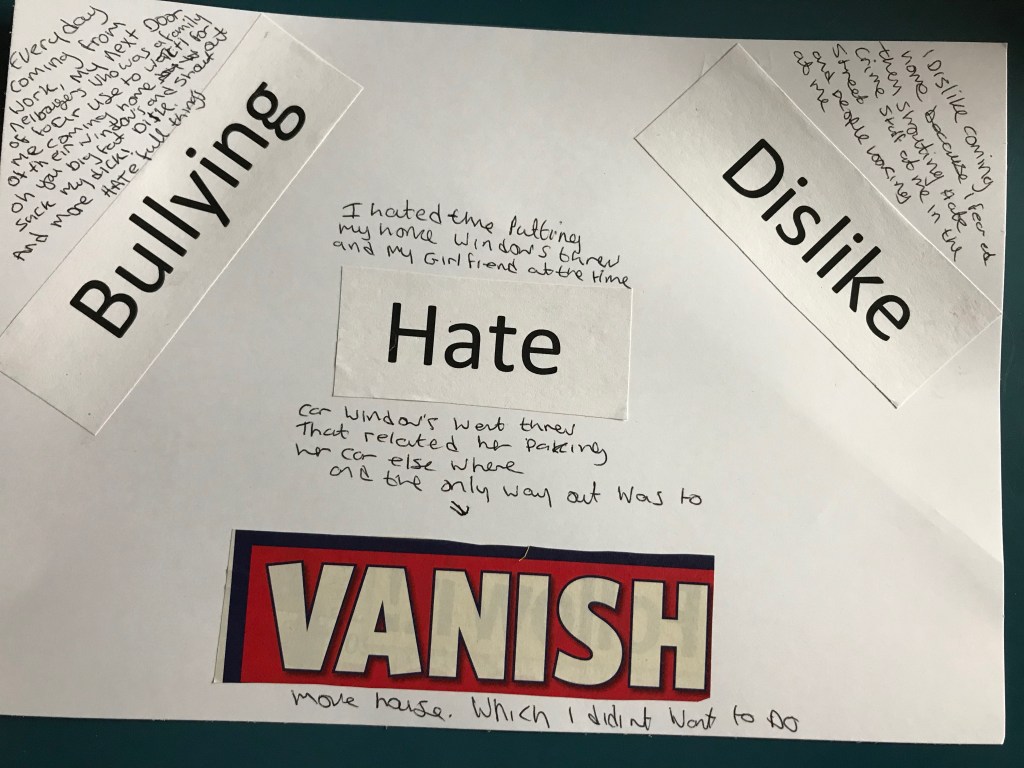
Robbie and Sapphire also said that experiences of hate left scars within their own minds and made them feel like they are not themselves anymore. Beater said that this made her want to hide away from other people and Kezza said that her only escape from hate was to vanish.
Additional labour

In order to manage experiences of hate, many participants developed strategies of avoidance. This could include avoiding certain places, or choosing to go to those spaces at particular times. For example, many participants chose to avoid using public transport before and after school due to the number of children and young adults.
If avoidance wasn’t an option then many participants described difficult conversations with people, or being asked personal questions about their impairment. These conversations can make people feel uncomfortable and like they do not belong to be in certain places. While participants explained wanting to challenge these conversations, many were worried that it could make the situation worse.
AND SO:
AND SO – there are many ways that hate crime can hurt and these can have long-lasting impacts. For some people, this involves having to plan their time in order to avoid certain places or people. For others, this involves taking time for self-care and relaxation. Unfortunately, many participants explained that they often had to ‘get on with it’ and accept that they are likely to experience hate.

