
In England and Wales, a hate crime is legally defined as: ‘Any criminal offence which is perceived by the victim or any other person, to be motivated by hostility or prejudice, based on a person’s disability or perceived disability; race or perceived race; or religion or perceived religion; or sexual orientation or perceived sexual orientation or transgender identity or perceived transgender identity’
Most participants agreed that it was difficult to assess the boundaries of hate crime – particularly when thinking about their own experiences. Although many participants shared their experiences of bullying, name-calling (Elvis; Paul), being laughed and stared at (Heather; Violet; Mickey; Joe), and being abused (Alex), they were unsure of what could be counted as a hate crime.

For many, these experiences happened on a daily basis. In particular, participants noted that verbal abuse and staring were the most common. In the mood-boards to the right, Violet has included images of people staring at one another, and the piercing eyes of a tiger staring to the camera to highlight this. Andrew writes about verbal abuse in his mood-board, and provides some examples.
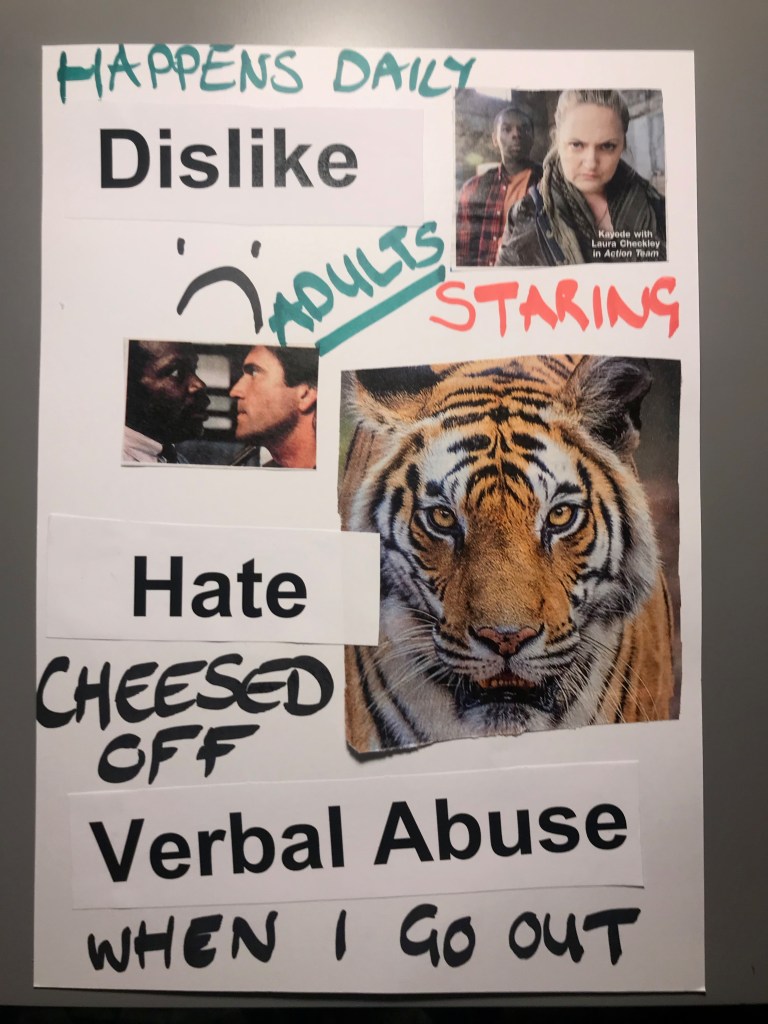

Violet: At the top are the words ‘happens daily’ and ‘adults staring.’ There is a magazine cut out-of two people looking angry facing towards the camera, and to the left a hand-drawn sad face above a picture of two men staring intensely at one another. In the centre is a large photo of a tiger looking intensely into the camera. Below are the words ‘hate’ ‘cheesed off’, and ‘verbal abuse when I go out’.
Andrew: The top right hand corner has a magazine cut-out of a women who looks badly beaten, with blood on her face and a swollen eye. This has the heading ‘lucky to be alive.’ Underneath this are the words ‘violence’ and ‘hate.’ In the centre is a magazine cut-out with the text ‘weird’ and ‘tramp.’ In the bottom right-hand corner of the page are the words ‘verbal abuse’, highlighted with green felt.
Some participants also spoke about ‘mate crime’ – a form of hate crime that is done to disabled people by ‘fake friends.’ This includes people being taken advantage of and used by people who they believe to be friends (Sabrina; Caitlin; Michael). Robbie also explained that this could be known as ‘cuckooing.’These types of experiences could also happen in relationships with family members and partners, as Fifi and Joyce described on their mood-boards. In their mood-boards, Fifi and Joyce write about their ex-partners who bossed them around, told them what to do, and manipulated them.
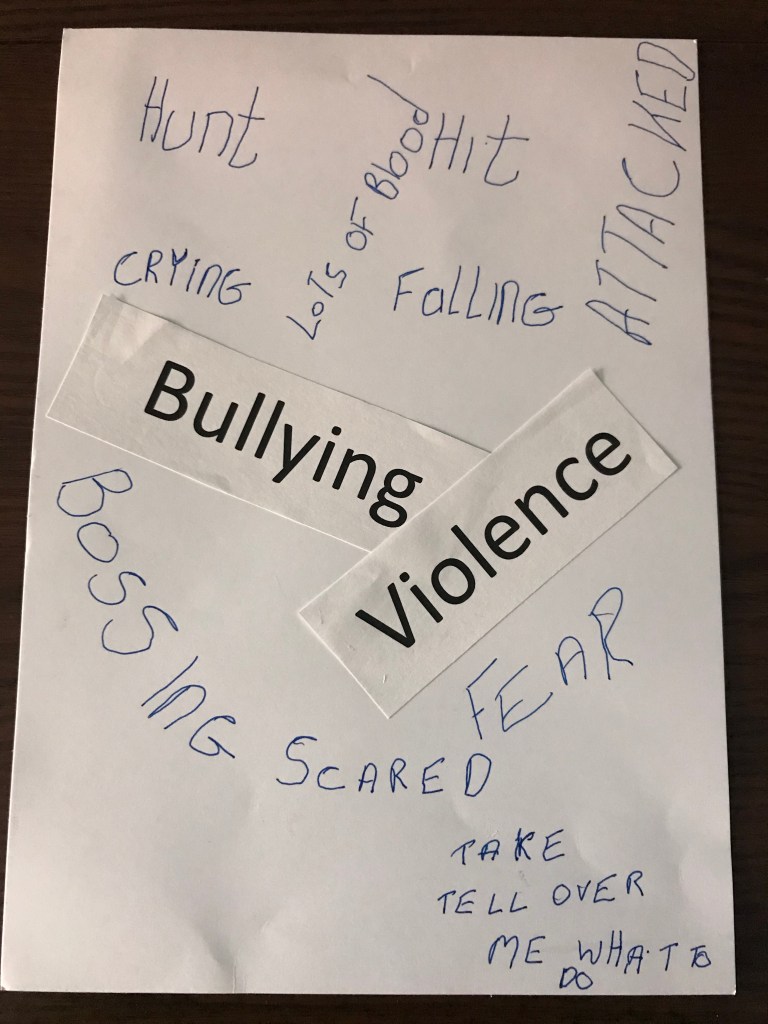

Joyce: The top of the page has the words ‘hunt’ ‘crying’ ‘lots of blood’ ‘hit’ ‘falling’ and attacked.’ In the centre are the words ‘bullying’ and ‘violence’ Below this are the words ‘bossing scared, fear’ and ‘take over, tell me what to do’
Fifi: The top left-hand corner has a magazine cut-out of two people standing next to each other wit the heading ‘abused in a cult by her own father’ which is next to the words intimidation/bossing, bullying, scared to answer back.’ Below are the words ‘vulnerability, resentment’ and the writing ‘person rub salt in wounds, off getting something I need. Below are the words ‘manipulation’ and ‘anger for letting it so far taking over my home’ and ‘anger bully’s cruel taunt at school’
Many participants also believed that the language of ‘hate crime’ was off-putting and was only for really serious incidents, like physical abuse (Francis Emerson; Harry). As a result, although most participants had experienced hateful incidents towards them, very few had reported these as hate crimes.
Although participants found it difficult to describe hate crime and confidently identify this in their lives, many did come to an understanding of why this happens. Hate crime was understood to target people who are perceived as ‘different’ or who are believed to be the reason for someone else’s difficulty. On his mood-board, Brandon used the word ‘targeted’ to explain this.
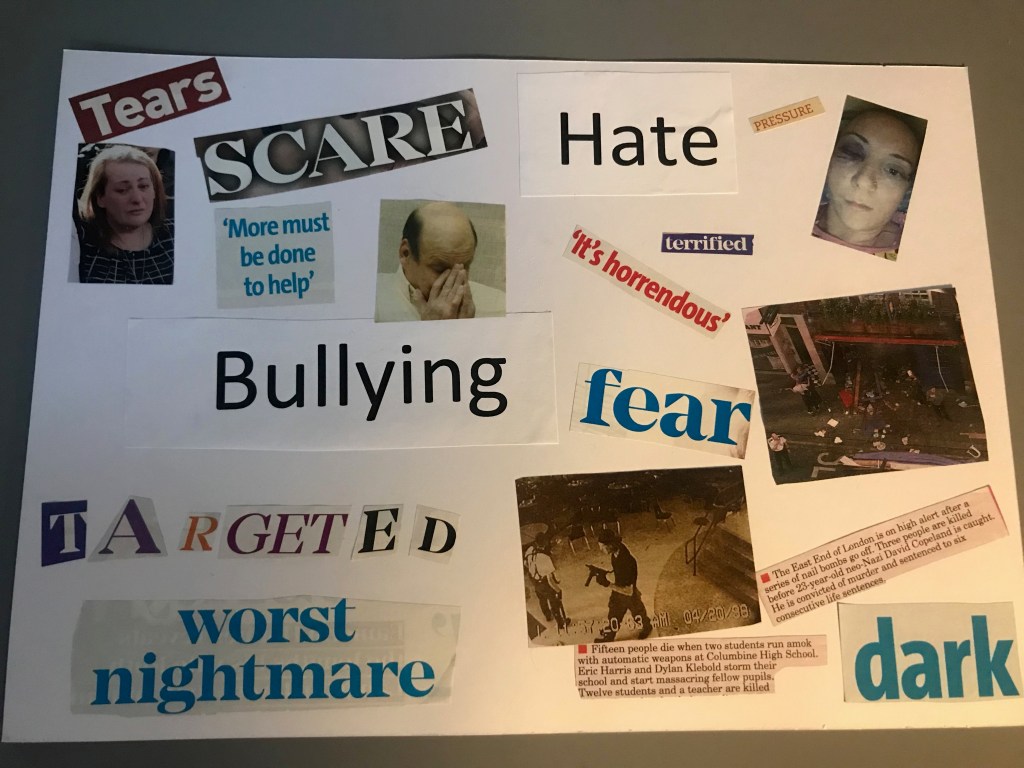
Brandon: The top left hand corner of this page has cut-outs which read ‘tears’ ‘scare’ and more must be done’ which is accompanied by two photos, one is a woman who looks upset and the other a man holding his head in his hands. Below this is the word ‘bullying’ and the word ‘targeted’ which has been constructed from letters out of the magazine. There is a cut-out at the bottom saying ‘worst nightmare’. On the right hand side are cut outs reading ‘hate’ ‘pressure’ ‘terrified’ ‘it’s horrendous’ ‘fear’ and ‘dark’. There are three images, the first is a woman who has a bruised eye, the second is of shop front which is covered in debris, labelled by an excerpt describing a nail bomb. The final image has a figure holding a gun, and is accompanied by a description about a school massacre in the US.
In addition, Joe, Alex and Ellie reflected upon their own experiences of being treated badly because they use a wheelchair while others commented upon the importance of body size and disability. Freddie’s mood-board describes his experience of being bumped into when using a wheelchair, and Dr Who concentrated upon weight.


Freddie: The top of the page reads ‘people banging into the chair and not looking at me as a person.’ Below are two magazine cut-outs of wheelchairs and the words ‘dislike’ and ‘resentment.’
Dr Who: The top of the page has the words ‘sexual abuse’ and underneath two photos of women, which are labelled to focus upon their weight. Below this are the words bullying, anger, violence and dislike. The bottom left hand corner has a photograph of a kitten.
Importantly – participants also spoke about the intersections of their identity. Recognising that disabled people also identity in lots of other ways (for example, gender, race, sexual orientation, social class, age) is important in understanding the complexity of people’s experiences. As shown in the image below, oppression (like hate crime) can occur at the intersection of these different identities.

AND SO –
These findings suggest that we need to open up our language for talking about hate crime to include all of those incidents (such as bullying and name-calling) that happen to many disabled people on a regular basis (Shaz). Hate crime can be understood in a range of different ways – and we need to work towards an appreciation of all of these.

Robbie: A number of words all situated within a large speech bubble. The words are: discrimination, hatred, spastic, anger, exploitation, dislike, victims, disgusted, bullying, threats, sexual abuse, name-calling, not treated equally, violence/violent, cuckooing, emotional abuse, financial abuse, manipulation, stigma, ignorant, listen, listened to, we are all human beings.
 Experiences of Everyday Hate: A PhD Project