
Creating safe spaces

Although experiences of hate crime can be very upsetting, many disabled people had developed their own techniques of coping with these, or challenging them directly. One way of doing this was the creation of ‘safe spaces.’ Safe spaces can be created anywhere. For example, Lynn felt safe when she was talking to her gaming community, and Maisie felt safe at choir practice with her friends. Others had supportive networks online or attended peer-support groups and disability organisations. Knowing where these spaces are is very important and participants were keen to encourage other disabled people to join a safe space. Safe spaces were also ones that were physically accessible for participants. For example, Doria Skadinski met up with friends every week in public, and had begun to create an ‘accessibility plan’ to help with this. By knowing where is and is not accessible, Doria Skadinski explained that being in public was much easier and less stressful.
Individual survival
Other techniques included relaxation, yoga, and meditation. Participants used these to help keep calm and comfortable.
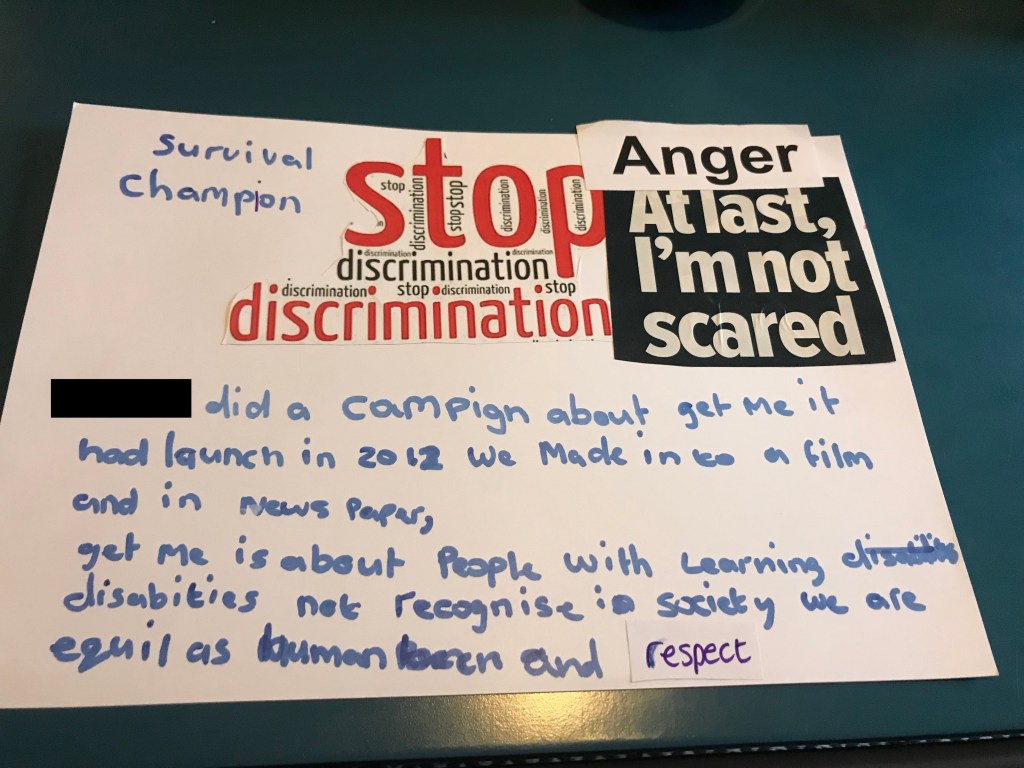
Some participants referred to themselves as a ‘survivor’ (Sabrina; Sinead; John Dovet) and a ‘champion’ (Sabrina) for overcoming their experiences of hate crime.
Sabrina: The top left hand corner has the words ‘survival’ and ‘campion’ next to a large cut-out of the words ‘stop discrimination’ repeatedly. To the right is the word ‘anger’ with the cut-out ‘at last I’m not scared’ underneath. Below is a passage of writing reading: ‘I did a campaign about get me it had launch in 2020. We made into a film and in newspaper. Get me is about people with learning disabilities not recognise in society as equil as human being and respect’
In particular, some participants recalled moments of resistance. For example, Fifi decided to take back her life after being abused by her father and husband, and Ellie had challenged shop assistants who had been ignoring her and instead talking to her carer when she was paying for purchases.
Working together as a collective

John Taylor often used humour to challenge hate in the moment. Humour was described to be particularly useful when educating others about disability in order to prevent future hateful encounters. Many participants believed that humour was also the most effective way to engage with children and young adults, and open up honest conversations about disability. In particular, participants believed that greater collaboration between disabled people and schools could help to educate young people about disability, and challenge the negative attitudes that they discussed.
Some organisations were already doing important work with schools. For example, Leep1 had performed drama pieces about ‘hate crime’ and ‘mate crime’ to teach children about their impacts. However, most participants agreed that more work needs to be done here.

Working together was very important for all of the organisations involved in the project. Participants felt that their organisations provided them with a safe space to share their experiences, meet new people, and make changes that can positively impact their lives. Some organisations worked with the police, local workplaces, and schools. For others, the most important thing was to create a supportive space for members to meet and share their experiences.
AND SO:
In the future, research needs to work with disabled people in the community from the very beginning. Many disabled people, organisations and peer-support groups are already working together to challenge hate crime against disabled people. And so, there is an opportunity to strengthen this by collaborating.

